

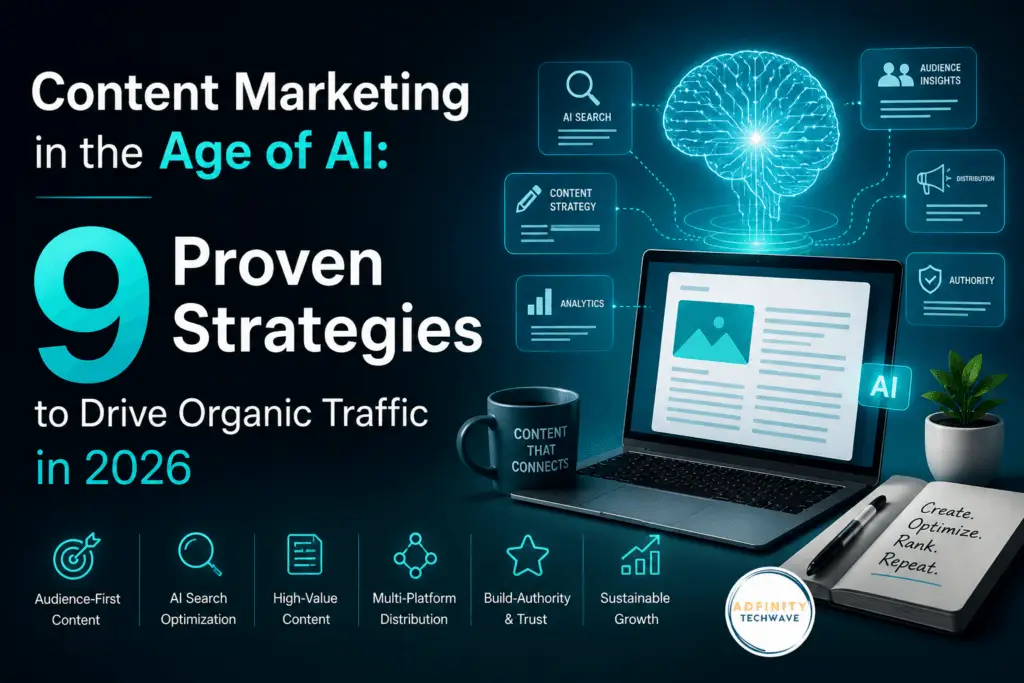
Introduction — Why Content Marketing in the Age of AI Needs a New Playbook
Content marketing in the age of AI is not a minor update to what worked in 2023. It is a structural redesign of how visibility is earned, measured, and compounded.
Here is the paradox every content team is living with right now. Organic search still drives nearly 47% of all web traffic and delivers a 748% ROI as a long-term channel — according to Averi’s 2026 State of AI in Marketing report. It remains the most sustainable and cost-effective source of qualified visitors. Nobody serious is abandoning it.
At the same time, AI Overviews now appear on up to 48% of all Google queries as of April 2026, reaching 2 billion monthly users — up from just 6.49% in early 2025. When an AI Overview is present, the zero-click rate climbs to 83%. When Google’s AI Mode handles the query, it reaches 93%.
The instinctive response from content teams — produce more, publish faster, chase more keywords — is precisely the wrong answer. According to Content Marketing Institute’s 2026 survey of 42 industry experts, 2026 is the year content marketing gets ‘punched in the face’ by AI-generated volume that floods every channel with fast, cheap, and forgettable output.
The brands succeeding at organic traffic content marketing in 2026 are not the ones publishing the most. They are the ones structuring content for AI extraction, building genuine topical authority, and earning citations from the AI systems that now curate discovery for billions of users every day.
This guide covers the 9 proven strategies that separate those brands from the ones watching their traffic plateau.
48% of Google queries trigger AI Overviews (Apr 2026) | 47% of all web traffic still comes from organic search | 83% zero-click rate when AI Overviews are present | 748% ROI from SEO vs paid ads over 12 months |
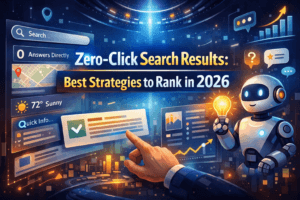
Strategy 1: Optimise for Zero-Click Visibility, Not Just Traffic
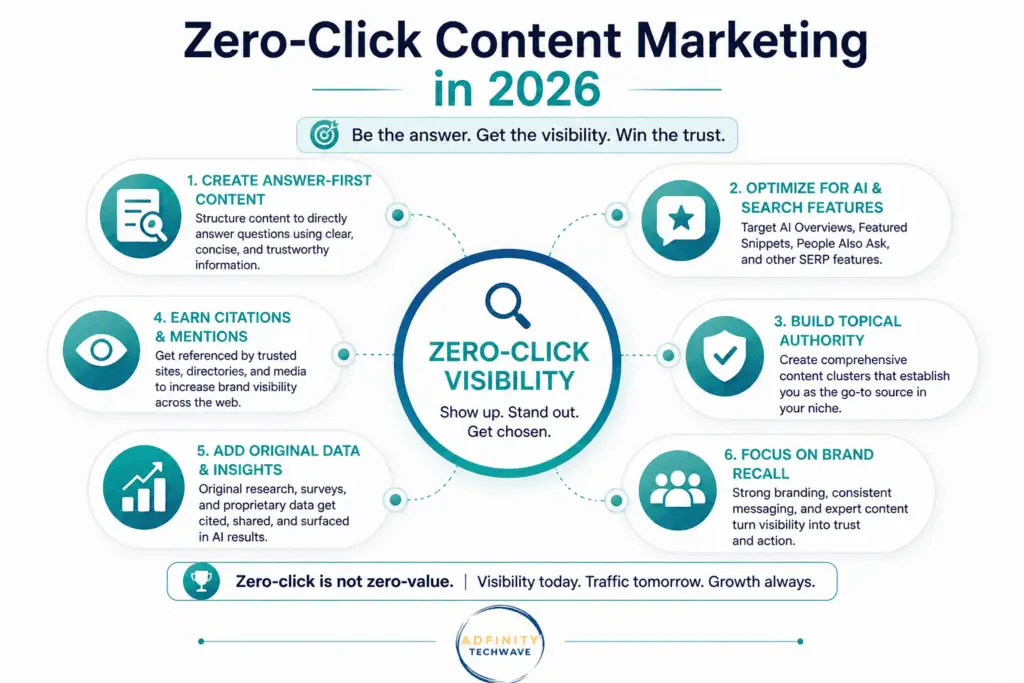
The most important mindset shift in content marketing in the age of AI is this: clicks are no longer the only measure of content value.
Zero-click content marketing in 2026 means designing content to appear in AI-generated answers — Featured Snippets, AI Overviews, PAA boxes — even when no click follows. Because appearing in those answers builds brand recognition and influences purchase decisions before the user ever visits your website.
WordStream’s 2026 content marketing trends report calls this ‘zero-visit visibility’ — the most influential content marketing trend of the year. The data confirms it. Seer Interactive’s April 2026 research found that organic CTR fell 61% when AI Overviews appear. But cited brands within those Overviews actually see a 35% higher organic CTR and 91% higher paid CTR compared to non-cited brands on the same queries.
The conclusion is clear. Being cited in an AI Overview is now more valuable than ranking third in traditional results.
What does this mean practically?
- Answer first, detail second — structure every H2 section with a direct 40–60 word answer in the opening lines. No preamble. AI systems extract from the first relevant sentence.
- Map query fan-outs — Google AI Mode and ChatGPT break a single query into multiple sub-queries. Map the questions embedded in your core topic and create content to answer each one. Use People Also Ask boxes and AnswerThePublic as your starting point.
- Target PAA boxes as H3 headings — include PAA questions as H3 headings and answer each in 2–4 direct sentences. Use Rank Math’s FAQ Block to generate FAQPage schema automatically.
- Track impressions alongside traffic — a page that earns 80,000 impressions and 3,000 clicks is not a failure. It is building brand awareness at scale through zero-click visibility.
For the complete AI citation framework, see our guide on AI-first SEO and generative search ranking.
Strategy 2: Build Proven Content Clusters for Topical Authority
Topical authority is the prerequisite for AI citation eligibility in content marketing in the age of AI. Both Google AI Overviews and ChatGPT prefer to cite sources that comprehensively cover a topic ecosystem, not sources with a single isolated article.
Backlinko’s 2026 analysis confirms that brands using content cluster architecture outcompete larger domains on specific topics by going deeper. Averi’s 2026 benchmarks report adds that companies publishing 16+ posts monthly see 3.5× more traffic — but only when each piece meets structural quality benchmarks: 2,100+ words, question-based headings, sourced statistics, and FAQ sections.
The content cluster build process:
1. Define the pillar — one comprehensive 2,500–3,500 word guide covering the core topic at full depth.
2. Map every subtopic — use Google PAA boxes, AnswerThePublic, and AI tools to identify the complete question universe around the core topic.
3. Create cluster articles for each subtopic — every piece answers a specific question comprehensively and links to the pillar bidirectionally.
4. Interlink consistently — the pillar links to every cluster article; every cluster article links back to the pillar. This is how topical authority accumulates over time.
5. Refresh quarterly — content updated in the past three months averages 67% more AI citations than outdated pages. Build a refresh calendar from day one.
Our guide on generative engine optimisation for small businesses covers the content cluster build process in practical detail, including the keyword mapping methodology we use for client engagements.
Strategy 3: Structure Every Piece for Proven AI Overview Extraction
Getting into a Google AI Overview requires understanding how Gemini 3 — powering AI Overviews since January 2026 — actually reads content. It does not scan for keywords. It evaluates factual density, structural clarity, and entity authority before deciding whether your content earns a citation.
According to SE Ranking’s 2025 research, pages using 120–180 words between headings receive 70% more AI citations than pages with dense, unbroken prose. According to Conductor’s Q1 2026 analysis of 21.9 million queries, 57.9% of AI Overview triggers are question-format queries — which means question-based headings are the most direct route to AI Overview inclusion.
The proven structure for AI Overview extraction:
1. Definitional lead — start every key section with ‘X is…’ or ‘X refers to…’. AI systems extract these as anchor definitions.
2. Direct answer in first 200 words — state the conclusion before the supporting argument. This is the TLDR-first principle that Enrich Labs’ 2026 GEO research documents as the top-performing content format for AI citation.
3. Short paragraphs — maximum 3 sentences per paragraph. AI systems extract from compact, distinct statements, not from dense prose blocks.
4. Descriptive subheadings — every H2 and H3 should function as a standalone answer. Vague headings like ‘More Information’ or ‘Overview’ earn zero citation value.
5. Lists for processes and comparisons — bullet and numbered lists are consistently over-represented in AI Overview citations compared to equivalent content buried in prose.
One insight that surprises many content teams: 76.1% of URLs cited in AI Overviews rank in the top 10 of traditional Google results — but 28.3% of ChatGPT’s most cited pages have zero organic visibility in Google. This means AI Overview and ChatGPT citation require different strategies, which leads directly to the next point.
Strategy 4: Apply Generative Engine Optimisation (GEO) Content Principles
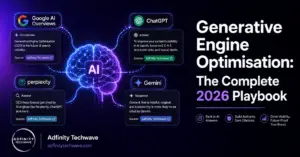
Generative engine optimisation content — GEO — is the fastest-growing discipline in digital marketing in 2026. As Search Engine Land defines it: ‘GEO is the practice of structuring content so that AI language models cite and recommend your brand in their generated answers.’
GEO extends content marketing in the age of AI beyond Google to ChatGPT, Perplexity, Microsoft Copilot, and Gemini. According to Digital Applied’s 2026 AI search statistics definitive guide, ChatGPT’s search delivers roughly 190× less referral traffic to websites than Google despite handling 12% of Google’s search volume — yet sidebar citations within ChatGPT achieve 6–10% CTR, comparable to Google’s organic positions 4 through 10. Citation placement within the AI response matters enormously.
The five GEO content principles that drive multi-platform citations:
1. Entity-first architecture — every key section opens with a definition sentence naming the entity precisely. AI systems extract these as trusted anchor references.
2. Factual density over keyword density — include specific project data, statistics, client outcomes, and verifiable claims. According to the typeface.ai 2026 content marketing statistics report, 86% of marketers plan to increase original research budgets because proprietary data is the new competitive moat. AI systems filter promotional generalities and reward informational specificity.
3. Schema markup as foundation — Article + FAQPage + Organization schema are the minimum for AI citation eligibility. Google and Microsoft have both publicly confirmed that structured data is the primary technical signal for AI feature inclusion.
4. Third-party citation building — earn editorial mentions in industry publications, niche directories, and community platforms like LinkedIn and Reddit. According to OtterlyAI’s April 2026 research, YouTube and Reddit combined account for 78.2% of AI social media citations.
5. Quarterly freshness protocol — content updated in the past three months averages 67% more AI citations. Display a visible ‘Last Updated’ date on every article and build a quarterly refresh workflow.
Semrush’s AI Visibility Toolkit is one of the best tools for monitoring generative engine optimisation content performance across ChatGPT, Gemini, and Perplexity. Track citation frequency monthly and use it to identify which pieces need structural improvement.
Strategy 5: Make Video a Proven Core Organic Traffic Channel
Video is no longer optional in organic traffic content marketing. Search results with video drive 157% more organic traffic than text-only pages. Video earns a 41% higher click-through rate and appears in 26% of Google’s search result thumbnails.
The reason video is especially critical in content marketing in the age of AI is Google’s 20-year integration with YouTube. According to WordStream’s 2026 trends analysis, YouTube is now cited in nearly 30% of all AI Overviews — meaning a well-optimised YouTube video can appear in both traditional search results AND AI Overviews simultaneously, doubling your visibility for a single piece of content.
How to make video a compounding organic asset:
1. Embed YouTube videos in your highest-traffic blog posts — Marketer Milk documented a position jump from 2–3 to number 1 on a competitive keyword simply by embedding a relevant YouTube video.
2. Optimise video titles as query-format headings — ‘How to [action] [object] in 2026’ consistently outperforms promotional titles in search.
3. Include a written transcript below every embedded video — this gives AI crawlers the text signals they need to parse and cite the video content.
4. Use video for process content specifically — step-by-step tutorials earn more shares and backlinks than text equivalents by a measurable margin.
5. Short-form video for social discovery — Instagram Reels and YouTube Shorts that link back to the long-form article create a multi-platform traffic loop that compounds over time.
The production quality bar is lower than most content teams assume. Authentic, expertise-driven video consistently outperforms high-production promotional video in search visibility and engagement metrics.
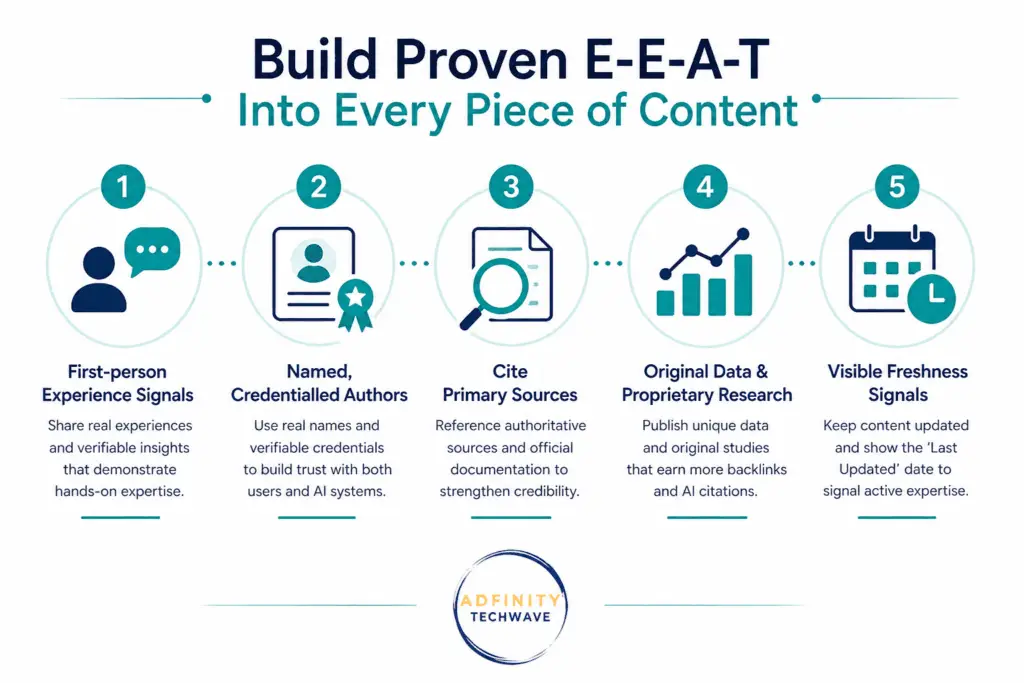
Strategy 6: Build Proven E-E-A-T Into Every Piece of Content
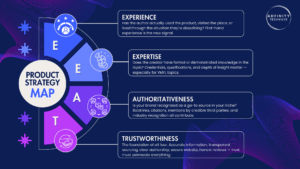
E-E-A-T — Experience, Expertise, Authoritativeness, and Trustworthiness — is no longer an optional SEO refinement in content marketing in the age of AI. It is the primary signal AI systems use to determine whether your content deserves to be recommended.
The February 2026 Google Core Update made this explicit, explicitly rewarding first-person experience signals over generic informational coverage. The question has shifted from ‘what does this content cover?’ to ‘who is writing this, and why should an AI system trust them?’
Practical E-E-A-T improvements that move the needle:
1. First-person experience signals — include verifiable statements like ‘In our work with 40+ brands…’ or ‘Based on direct testing over six months…’. These are what the February 2026 Core Update explicitly rewards.
2. Named, credentialled authors — every piece needs a named author with a verifiable professional history. Anonymous content pages signal low trustworthiness to both Google and AI systems.
3. Cite primary sources — reference Google Search Central, peer-reviewed research, and official platform documentation. AI systems cross-reference your citations when assessing trustworthiness.
4. Original data and proprietary research — Backlinko’s 2026 analysis confirms that ‘Be The Source’ content — original studies and proprietary datasets — earns significantly more backlinks and AI citations than secondary coverage of existing research.
5. Visible freshness signals — display a ‘Last Updated’ date on every article. Stale content is not just a ranking liability — it is an active E-E-A-T signal that the brand does not maintain its own expertise.
Our comprehensive guide on E-E-A-T strategy and building brand trust for AI-driven search covers the full implementation methodology, including the author bio framework and credential documentation process.
Strategy 7: Repurpose Deeply — The Proven Content Multiplier Approach
The most efficient content teams in content marketing in the age of AI are not the ones publishing the most. They are the ones extracting maximum value from every piece created. One deep article becomes 6+ pieces of traffic-driving content across channels — each driving traffic back to the source asset.
Source — Long-form pillar article | 2,800–3,500 word comprehensive guide on the core topic |
Derivative 1 — YouTube video | Full-length tutorial or walkthrough from the same research |
Derivative 2 — Short-form video | 60-second key takeaway clip for Reels / YouTube Shorts |
Derivative 3 — LinkedIn article | Condensed version with first-person commentary and business angle |
Derivative 4 — Email newsletter | Key findings and actionable steps for the subscriber list |
Derivative 5 — Social thread | 10-point thread distilling the most shareable insights for X / LinkedIn |
Derivative 6 — Podcast episode | Audio walkthrough of the topic, uploaded to YouTube and Spotify |
The compounding effect of this approach is why content clusters built around one strong pillar can drive organic traffic content marketing results for years without proportionate ongoing investment. The critical rule: each derivative must be genuinely adapted for its platform — not copied. Google’s 2026 Discover updates explicitly suppress repurposed copies with no additional insight.
Strategy 8: Optimise Social Search as a Parallel Discovery Channel
One of the most underestimated developments in content marketing in the age of AI is the emergence of social platforms as primary search engines in their own right.
According to Promodo’s 2026 research citing Sprout Social data, 41% of Gen Z users search for places, products, and services directly on Instagram and TikTok — and only 32% of people aged 13–28 use traditional search as their primary discovery channel. For brands targeting this demographic, social SEO is the primary channel.
Social SEO strategies that drive measurable reach:
1. Instagram SEO — use keyword-rich captions (not just hashtags), include location context, and write descriptive alt text for every image. Since mid-2025, Google indexes public Instagram content from professional accounts — a well-structured post can appear in Google search results directly.
2. TikTok Trend Discovery — TikTok’s official trend discovery tool shows trending keywords and sounds in real time. Create content at the inflection point of a rising trend, before competition peaks.
3. YouTube as an SEO content library — treat every YouTube upload as a long-term SEO asset, not a social media post. YouTube is the second-largest search engine globally and is indexed by Google.
4. LinkedIn for professional authority — LinkedIn is the most-cited domain for professional queries across all major AI platforms in 2026, including ChatGPT, Gemini, Copilot, and Perplexity. Consistent LinkedIn publishing builds the entity authority that feeds directly into AI citation eligibility.
Our guide on local SEO for small businesses includes a practical social SEO framework for brands with physical locations, where social search and local search intersect directly.
Strategy 9: Measure What Actually Matters in 2026
The final strategy in content marketing in the age of AI is the one most teams are getting wrong: measurement. Traditional reporting built around organic sessions and CTR now captures less than half the value content generates — because the majority of content value in 2026 is delivered through AI citations, impressions, and zero-click brand exposures that produce no session in Google Analytics.
The two-track measurement model:
Track 1: Traditional organic performance |
Clicks and sessions from organic search — primary revenue signal |
Keyword rankings — page 2 to page 1 movements drive real traffic |
Click-through rate by page — identify high-impression, low-CTR pages |
Conversion rate by content type — which formats convert best |
Scroll depth and time on page — engagement signals that predict ranking durability |
Track 2: AI visibility performance |
AI Overview citation frequency — manual tracking across 25–30 target queries |
ChatGPT, Perplexity, Gemini citations — use Semrush AI Visibility Toolkit |
Branded search volume — rising branded search = zero-click AI exposure working |
AI referral traffic — segment in GA4 to identify quality vs volume |
Share of voice in AI — benchmark your citation rate vs top 5 competitors |
The critical warning from Search Engine Land’s 2026 content strategy guide: Ghost Rankings. This is when ChatGPT or Perplexity cites your content but recommends a competitor for the actual purchase. You are visible, you are being cited — and you are still losing the conversion. This is a measurement problem you cannot fix without both tracks running simultaneously.
Key Takeaways
The 9 strategies in this guide add up to a single governing principle: content marketing in the age of AI rewards brands that structure content for machines while writing it for humans. The two goals are not in conflict. They are complementary.
The brands winning organic traffic in 2026 are consistently doing four things:
1. Creating genuinely useful, factually dense content that answers specific questions directly and completely — not promotional overviews.
2. Structuring content with the technical signals AI systems need: schema markup, TLDR-first formatting, descriptive headings, and short paragraphs.
3. Building topical authority through content cluster architecture — not isolated articles.
4. Measuring across both traditional organic performance and AI visibility, treating both as equally valid indicators of content value.
"2026 is the year content marketing gets punched in the face. AI is flooding every channel with fast, cheap, and forgettable outputs. The brands that survive will be the ones who went deeper, not faster."
Content Marketing Institute — 42 Experts Reveal Top Content Marketing Trends for 2026
External Resources & Further Reading
The strategies in this guide are grounded in verified 2026 research on content marketing in the age of AI and AI-driven organic traffic growth:
1. WordStream — ‘The 8 Most Influential Content Marketing Trends for 2026’ — zero-visit visibility, query fan-outs, and multimedia strategy
2. Backlinko — ’11 Content Marketing Trends for 2026′ — Be The Source content, experience-based writing, and content operations at scale
3. Semrush AI Visibility Toolkit — multi-platform citation monitoring across ChatGPT, Google AI Overviews, and Perplexity
4. Google Search Central — official structured data documentation for Article, FAQPage, and Organization schema
Frequently Asked Questions
What is content marketing in the age of AI?
How do AI Overviews affect my content marketing strategy?
Is zero-click content marketing bad for business?
What is the difference between SEO and GEO for content marketing?
How to Change my Photo from Admin Dashboard?
How many pieces of content should I publish monthly in 2026?
How do I get my content cited in Google AI Overviews?
Ready to make your content visible in AI-driven search?
Adfinity Techwave builds content marketing strategies that rank in Google, earn citations in AI Overviews, and drive measurable organic footfall for growing businesses worldwide.