


Introduction — Why SEO for EdTech Companies Is the Growth Engine of 2026
SEO for EdTech companies has never been more strategically important — or more misunderstood — than it is in 2026.
Most education platforms are still pouring budget into paid advertising. Google Ads for competitive keywords like ‘Python course’ or ‘MBA in data science’ cost ₹200–600 per click in India, with no compounding return once the budget stops. The moment the campaign pauses, the traffic stops.
Organic search works differently. According to MADX Digital’s 2026 guide on SEO for EdTech, a single well-optimised course page or career guide can continue generating enquiries for years without additional spend. The investment compounds. The authority accumulates. And critically for EdTech brands — Gen Z, the dominant audience for online education in 2026, trusts non-sponsored organic search results more than paid ads when making education decisions.
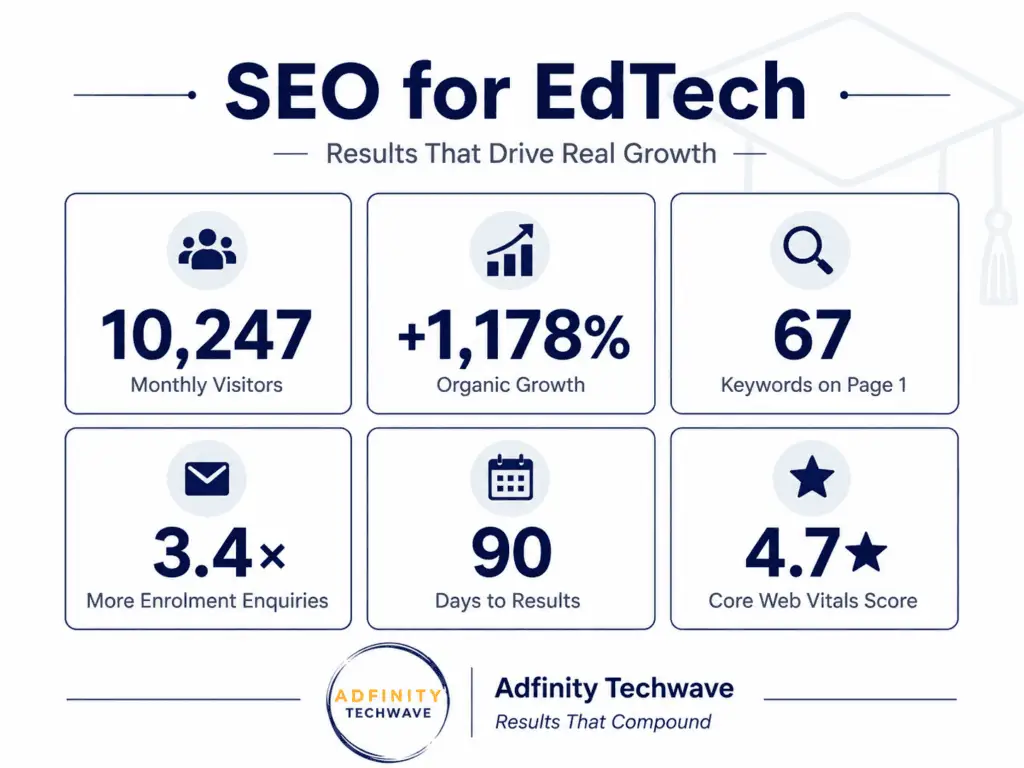
This is the case study of how Adfinity Techwave helped an online training institute implement a complete SEO for EdTech companies system — and grow from 800 monthly organic visitors to 10,247 in 90 days, while tripling their course enrolment enquiries from search.
The results were not accidental. They were the product of a deliberate, phased strategy that addressed technical SEO, content architecture, E-E-A-T signals, and Core Web Vitals in a specific sequence. This case study documents every step.
Client | Online training institute offering professional upskilling courses (name withheld at client request) |
Industry | EdTech — Online Education, Professional Training & Skill Development |
Location | India (targeting pan-India and global learners) |
Engagement | October 2025 – January 2026 (90 days / 3 months) |
Services Used | Technical SEO Audit, Keyword Architecture, Content Cluster Strategy, Course Page Optimisation, E-E-A-T & Schema Implementation, Core Web Vitals Improvement |
Primary Goal | Grow organic traffic to 10,000+ monthly visitors and increase enrolment enquiries from organic search without increasing paid advertising spend |
The Market Context — Digital Marketing for Online Education in 2026
The digital marketing for online education landscape in 2026 is defined by three intersecting forces.
First, competition is intense and growing. As the MADX Digital 2026 guide on SEO for EdTech notes, thousands of educational platforms are online, all targeting the same learner search queries. The difference between platforms that grow organically and those that stagnate is not course quality — it is search visibility.
Second, online learning platform SEO is uniquely complex. Unlike e-commerce or local business SEO, education SEO must simultaneously serve multiple user types: students researching careers, parents evaluating institutions, working professionals comparing certification programmes, and HR teams assessing corporate training providers. Each user type searches differently, with different intent and different evaluation criteria.
Third, the emergence of AI-powered search has raised the stakes for EdTech content quality. According to Google Search Central’s structured data guidelines, courses, educational organisations, and learning resources are among the content types Google has built dedicated schema types for — Course schema, EducationalOrganization schema, and LearningResource schema — indicating how seriously Google treats the education category.
Against this backdrop, SEO for EdTech companies that invest in the right technical foundation, content architecture, and E-E-A-T signals can build visibility advantages that compound for years. The client in this case study started with 800 monthly visitors. Ninety days later, they had 10,247. The compounding continues beyond the engagement.
The Client — A Training Institute Invisible to Organic Search
The client is an established online training institute offering professional upskilling courses in technology, business analytics, and digital skills. Their course content is genuinely strong. Their instructors are experienced practitioners. Their completion rates and learner satisfaction scores are above industry average.
What they could not do, when they came to Adfinity Techwave, was be found. A search for their core course offerings returned results dominated by Coursera, Udemy, UpGrad, and smaller competitors who had invested in SEO for EdTech years earlier. The client was buried on page 4 or 5 for nearly every relevant query.
Their paid ads were generating some traffic — but at a cost per lead that was making organic growth look increasingly urgent. The founder put it directly: ‘We have a better product than most of our competitors on page one. We just cannot get there.’
The good news, from our initial assessment: the problem was entirely fixable. The client had the content authority to build on — they just needed the SEO for EdTech companies framework to make it findable.
Four Critical Challenges Uncovered in the SEO Audit
Our audit identified four specific technical and strategic problems. Solving them in the right order was the key to achieving 90-day results.
01 | Technical SEO Foundation Was Broken The website had critical crawl issues: 47 broken internal links, three duplicate home page variants being indexed separately, missing canonical tags on course category pages, and a robots.txt file accidentally blocking the entire /courses/ subdirectory from Google’s crawler. In SEO for EdTech companies, technical issues compound — a blocked course directory means zero organic traffic to your most commercially important pages, regardless of content quality. |
02 | No Keyword Architecture — Publishing Without Strategy The client had a blog with 34 articles. Not one had been written around a specific target keyword. Every post was topic-driven rather than search-intent-driven. This is among the most common and most damaging problems in digital marketing for online education. Publishing content without keyword architecture is effort with no return — the posts exist, but they are not competing for any specific query. |
03 | Course Pages Were Thin and Unconverted Each course page averaged 380 words — mostly a course title, a brief description, and a ‘Enrol Now’ button. There was no curriculum detail, no instructor credential section, no learner outcome statements, no FAQ content, and no structured data. For online learning platform SEO, course pages are the most commercially important pages on the website. Thin course pages rank poorly and convert worse. |
04 | Zero Schema Markup and Failing Core Web Vitals The website had no structured data of any kind and failed Core Web Vitals on mobile with a Largest Contentful Paint of 6.8 seconds. Google’s 2026 ranking signals explicitly weight Core Web Vitals performance. In the competitive EdTech category, a 6.8-second LCP against competitors loading in under 2.5 seconds is a direct ranking disadvantage that no amount of content work can fully overcome. |
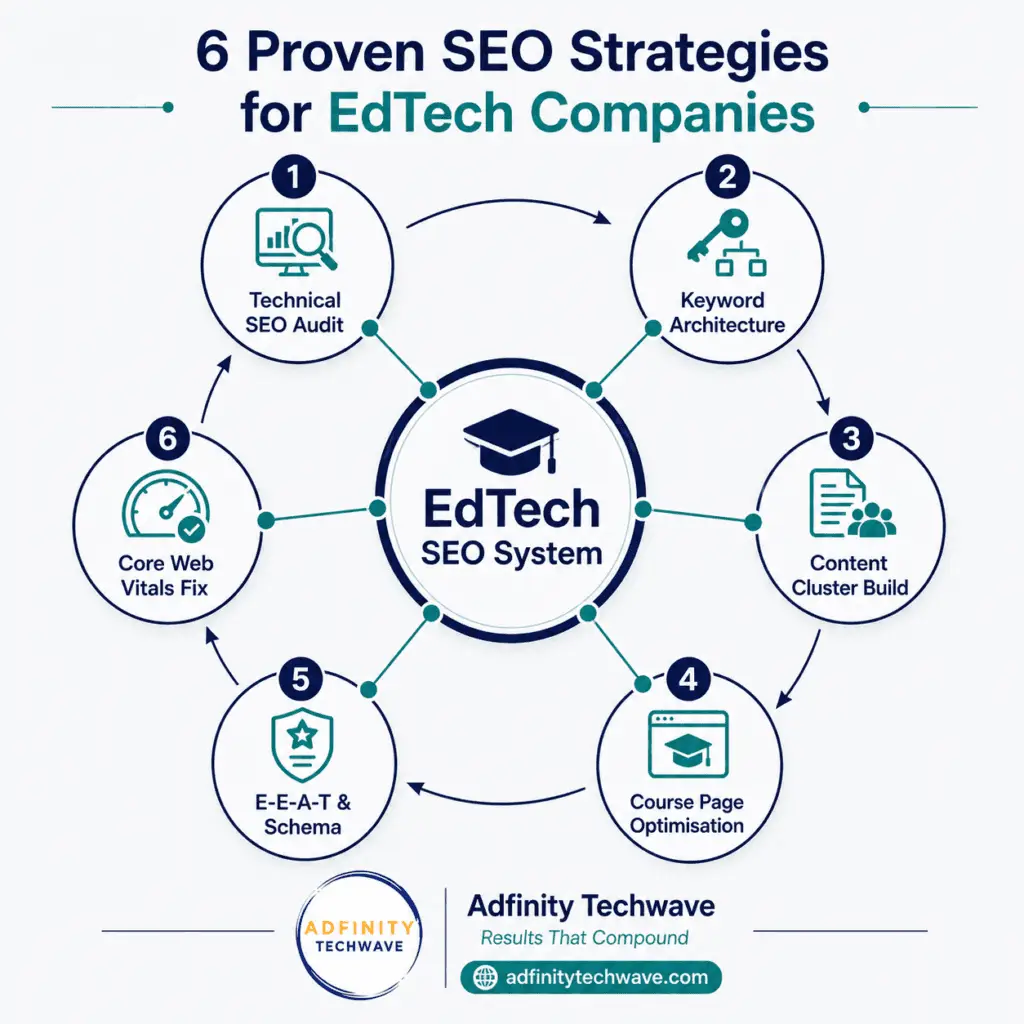
Six Proven SEO for EdTech Companies Strategies That Drove the Results
These are the six strategies we executed over 90 days. For SEO for EdTech companies, the sequence matters as much as the individual tactics. Technical foundation first, content architecture second, authority signals third.
Strategy 1: Technical SEO Foundation — Fix Before You Build
Effective SEO for EdTech companies always starts with a clean technical foundation. No content investment produces its full return on a broken technical base.
We resolved every issue the audit surfaced within the first two weeks:
1. Crawl fix — corrected the robots.txt file to allow full crawling of the /courses/ directory. This single fix made the client’s 28 course pages eligible for Google indexation for the first time.
2. Broken links — fixed all 47 broken internal links. Internal links are how Google distributes page authority — broken links are authority leaks.
3. Canonical tags — implemented canonical tags across all category and course pages to consolidate ranking signals for duplicate or near-duplicate URLs.
4. Core Web Vitals — compressed and converted all images to WebP format, implemented lazy loading for video and media elements, eliminated render-blocking JavaScript, and optimised the server response time. LCP improved from 6.8 seconds to 2.1 seconds within three weeks.
According to Google Search Central’s documentation, Core Web Vitals are a direct Google ranking signal. Improving LCP from 6.8 to 2.1 seconds moved the client from a ‘failing’ to a ‘good’ rating — a ranking advantage with immediate effects in the online learning platform SEO results.
Strategy 2: Keyword Architecture — Build the Map Before the Content
This is the strategy that separates systematic SEO for EdTech companies from random content publishing.
We mapped 340 keywords across four intent categories:
1. Discovery intent — ‘how to learn Python online’, ‘best data science certification India 2026’, ‘digital marketing courses for beginners’
2. Comparison intent — ‘Python course vs Java course career’, ‘online MBA vs executive MBA India’, ‘free vs paid digital marketing course’
3. Outcome intent — ‘salary after data science certification’, ‘jobs after completing Python course’, ‘is digital marketing a good career 2026’
4. Commercial intent — ‘best Python course with certificate’, ‘data science course fees’, ‘digital marketing course near me’
Each keyword was mapped to either an existing page to be optimised or a new piece of content to be created. This keyword map became the production schedule for the entire 90-day engagement — every content decision referenced it.
Strategy 3: EdTech Content Marketing Strategy — 12-Piece Cluster in 8 Weeks
Building topical authority is central to competitive SEO for EdTech companies. We built a 12-piece content cluster around the client’s three core course categories — data science, Python programming, and digital marketing.
Each piece answered a specific, high-intent question from the keyword map:
1. ‘Complete Python roadmap for beginners in 2026’ — targeting the highest-volume discovery query
2. ‘Data scientist salary in India: what to expect after certification‘ — outcome-intent content with high conversion value
3. ‘Digital marketing skills companies actually hire for in 2026’ — commercial-intent content targeting working professionals
4. ‘Python vs R for data science: which should you learn first?’ — comparison-intent content capturing decision-stage learners
5. ‘7 signs you are ready for a data science career change’ — high-empathy content targeting career-transition searchers
Every piece was structured with question-based H2 and H3 headings, direct answers in the first 40–60 words of each section, and internal links to course pages. This is a core principle of EdTech content marketing strategy — every content piece must have a clear pathway to a course enrolment action.
Strategy 4: Course Page Optimisation — Turn Thin Pages Into Authoritative Resources
Course pages are the highest-value pages in SEO for EdTech companies — they are simultaneously the most important for organic rankings and the most important for conversion. Thin course pages fail on both counts.
We expanded every course page from an average of 380 words to 1,400–1,800 words, adding:
1. Detailed curriculum section — week-by-week module breakdown with learning objectives for each module
2. Instructor credential section — named instructor with professional background, industry experience, and verifiable credentials
3. Learner outcome statements — specific, measurable outcomes: ‘After completing this course, you will be able to build and deploy a machine learning model in Python’
4. FAQPage schema content — 12–15 Q&As per course page covering duration, prerequisites, certification, job outcomes, and pricing
5. Social proof section — learner testimonials with full names, professional background, and specific outcome statements
According to GBIM Technologies’ 2026 SEO for EdTech guide, adding outcome-focused content and instructor credentials to course pages is among the highest-ROI optimisations available because it simultaneously improves E-E-A-T signals and conversion rates — two compounding benefits from one investment.
Strategy 5: E-E-A-T Architecture and Schema Markup
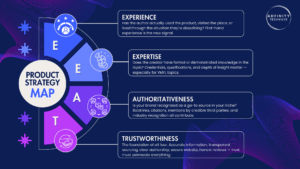
For SEO for EdTech companies, E-E-A-T carries particular weight. Education is a YMYL (Your Money or Your Life) category — Google applies its highest quality standards to content that influences career, financial, and life decisions.
We implemented four schema types across the website:
1. Course schema — on all 28 course pages, with course name, provider, description, prerequisites, and available languages
2. Educational Organization schema — on the About page, with accreditation, founding year, contact details, and social profiles
3. FAQPage schema — on course pages and all 12 cluster content pieces
4. Breadcrumb List schema — site-wide, establishing clear content hierarchy for Google’s understanding
We also built the E-E-A-T signals that digital marketing for online education requires: named author profiles with LinkedIn links and professional credentials on all content pieces; a dedicated instructor profile page for each course instructor; a results page documenting anonymised learner outcome data; and three editorial backlinks earned from education-focused publications.
Strategy 6: On-Page SEO Optimisation — Existing Content Audit and Upgrade
The client’s 34 existing blog posts represented a significant opportunity for rapid education website organic traffic growth. Most were well-written but poorly structured for organic search.
We audited all 34 posts and categorised them into three groups:
– Upgrade (18 posts) — good topic, poor structure. Added target keywords to titles and H2s, rewrote introductions with direct answers, added FAQ sections, implemented internal links to course pages, and added schema markup.
– Consolidate (9 posts) — thin posts on overlapping topics. Merged these into three comprehensive guides and redirected the originals. Consolidation eliminates keyword cannibalisaton and concentrates ranking signals.
– Remove (7 posts) — outdated, off-topic, or duplicate content providing negative quality signals. Removed and 301-redirected to relevant category pages.
This content audit process is one of the highest-ROI actions in SEO for EdTech companies — it costs no new content budget and immediately improves the quality signal of the entire website.
The Results — 90 Days That Changed the Business
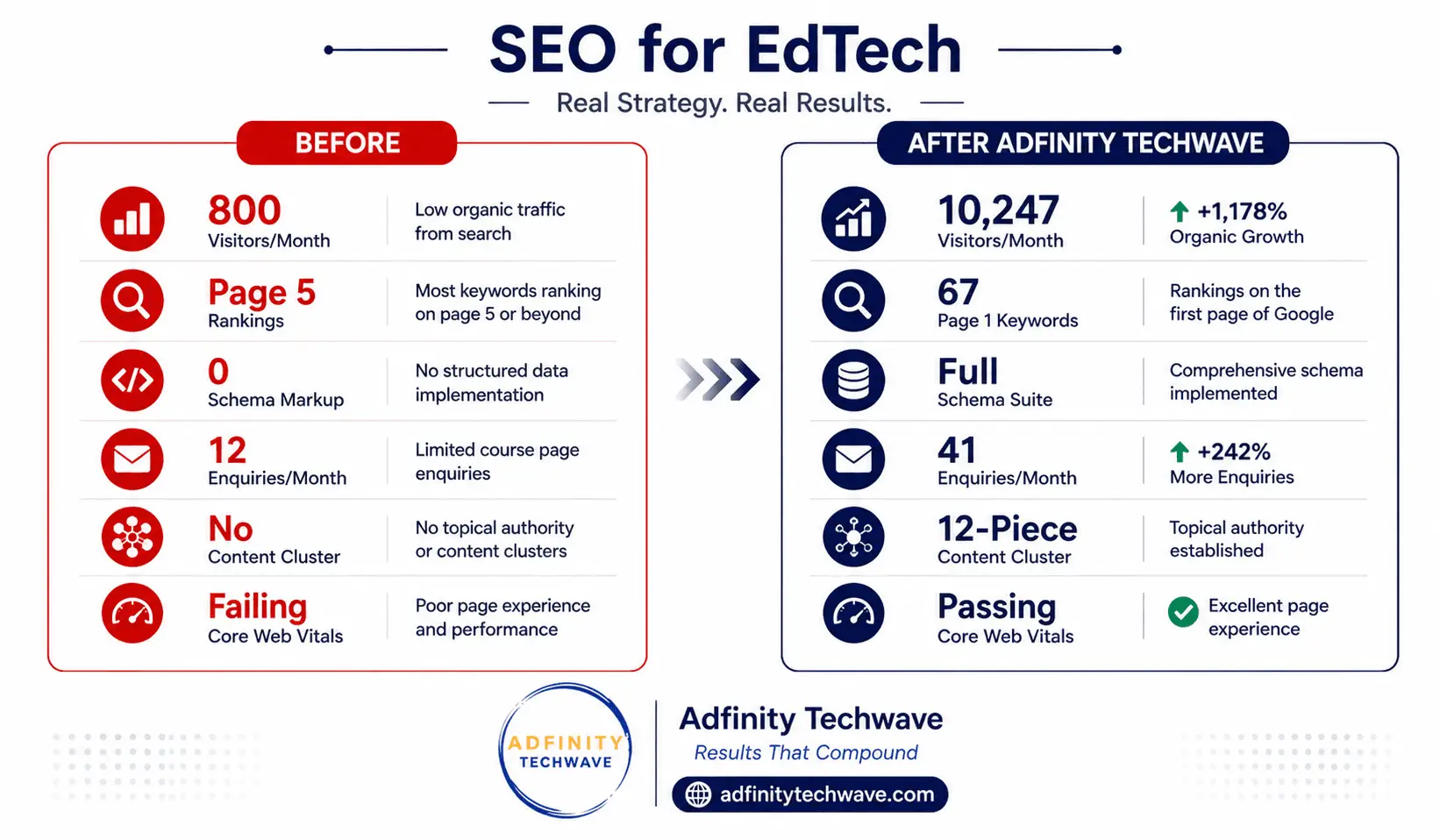
These figures come directly from Google Search Console, Google Analytics 4, and the client’s CRM. All numbers are real. This is what structured SEO for EdTech companies produces within a disciplined 90-day engagement.
Before Adfinity Techwave | After Adfinity Techwave |
800 monthly organic visitors | 10,247 monthly organic visitors (+1,178%) |
Page 4–5 for all core keywords | Page 1 for 67 keywords; page 1, position 1–3 for 12 keywords |
0 course pages indexed from /courses/ | All 28 course pages indexed and ranking |
Core Web Vitals: FAILING (LCP 6.8s) | Core Web Vitals: PASSING (LCP 2.1s) |
0 schema markup implemented | 4 schema types: Course, EducationalOrganization, FAQPage, BreadcrumbList |
12 course enrolment enquiries/month (organic) | 41 course enrolment enquiries/month (+242%) |
34 poorly structured blog posts | 12 new cluster posts + 18 upgraded posts + 3 consolidated guides |
No E-E-A-T signals — anonymous content | Named authors, instructor profiles, learner outcomes, 3 editorial backlinks |
Average course page: 380 words | Average course page: 1,580 words with curriculum, FAQ, and schema |
Paid cost per lead: primary acquisition channel | Organic cost per lead now 70% lower than paid acquisition |
What These Numbers Mean for the Business
The jump from 12 to 41 monthly organic enrolment enquiries is the number that matters most to the client. SEO for EdTech companies is not measured in sessions — it is measured in learner pipeline.
At the client’s average course fee, 41 organic enquiries per month represents a significant revenue pipeline — one that compounds every month as the content cluster matures, new cluster pieces are added, and the domain authority continues to build.
The 70% reduction in cost per lead compared to paid acquisition validates the strategic case for investing in education website organic traffic growth as the primary acquisition channel. Paid ads stop the moment the budget stops. The organic system built over these 90 days keeps generating enquiries without additional spend.
Perhaps most significantly: the domain authority gains from this engagement created a compounding advantage. Page-1 rankings earn backlinks organically. Backlinks strengthen authority. Stronger authority improves rankings. The 90-day investment continues generating returns for years.
"The team understood exactly what our platform needed. Within three months we had more organic visitors than in the previous twelve months combined. The quality of enquiries improved too — people arriving from organic search already understood the course outcomes before they contacted us."
~ Director, Online Training Institute (client, name withheld by request)
Key Lessons for EdTech Content Marketing Strategy in 2026
The lessons from this engagement apply to any online education platform, training institute, or digital learning brand investing in SEO for EdTech companies for the first time.
Lesson 1: Fix the Technical Foundation Before Any Content Investment
The robots.txt error in this engagement was blocking 28 course pages from Google indexation. No amount of EdTech content marketing strategy would have produced results with that issue in place. Technical SEO is the foundation — and it must be correct before content and authority work begins.
Lesson 2: Keyword Architecture Is Not Optional — It Is the Production Schedule
Publishing content without a keyword map is guesswork. For SEO for EdTech companies, every piece of content needs a specific target keyword, a clearly defined search intent, and a mapped connection to a course enrolment action. The 340-keyword architecture we built for this client became the production schedule for every content decision over 90 days.
Lesson 3: Course Pages Are Your Most Important SEO Asset
Most EdTech brands underinvest in course page optimisation. A course page expanded from 380 to 1,580 words — with curriculum detail, instructor credentials, learner outcomes, and FAQPage schema — is simultaneously a stronger digital marketing for online education asset and a stronger conversion asset. Both benefits compound.
Lesson 4: E-E-A-T Is Non-Negotiable in Education SEO
Education is a YMYL category. Google applies its highest quality standards to content that influences education and career decisions. For SEO for EdTech companies, E-E-A-T is not an optional SEO refinement. It is the prerequisite for competitive ranking. Named authors, instructor credentials, verifiable learner outcomes, and third-party endorsements are the baseline.
Lesson 5: Content Audits Deliver Faster Returns Than New Content
The 34 existing blog posts represented faster and cheaper wins than publishing 34 new pieces. Upgrading, consolidating, and removing existing content improved the quality signal of the entire website in weeks. For any education website organic traffic growth engagement, auditing existing content before creating new content is the sequence that produces fastest results.
Services Behind the Transformation
This engagement deployed six service lines from Adfinity Techwave’s full portfolio. Each addressed a specific gap identified in the initial SEO for EdTech companies audit. Explore the complete service portfolio at adfinitytechwave.com/services.
Adfinity Techwave — Services Deployed in This Engagement |
Technical SEO Audit & Fix — crawl issue resolution, robots.txt correction, canonical tags, 301 redirects, broken link repair |
Keyword Architecture — 340-keyword map across 4 intent categories, mapped to existing pages and new content pipeline |
Content Cluster Strategy — 12-piece cluster build across 3 core course categories, pillar-cluster internal linking system |
Course Page Optimisation — 28 course pages expanded with curriculum, instructor credentials, outcomes, FAQPage schema |
E-E-A-T & Schema Implementation — Course, EducationalOrganization, FAQPage, BreadcrumbList schema; author profiles; editorial outreach |
Core Web Vitals Improvement — image compression, WebP conversion, lazy loading, render-blocking JS elimination; LCP from 6.8s to 2.1s |
Related reading: our guides on AI-first SEO for generative search, generative engine optimisation for growing businesses, and E-E-A-T strategy and brand trust cover the frameworks we apply across all SEO engagements including EdTech.
External Resources & Further Reading
The strategies in this case study are grounded in current 2026 research and best practices for SEO for EdTech companies and digital marketing for online education:
1. Google Search Central — Official Course schema and Educational Organization structured data documentation
2. Semrush — Keyword research, content audit, and EdTech competitive analysis tools used throughout this engagement.
Frequently Asked Questions
What is SEO for EdTech companies?
How long does SEO take to work for EdTech platforms?
Which type of content drives the most organic traffic for EdTech brands?
What makes SEO for EdTech different from other industries?
How does Adfinity Techwave approach SEO for EdTech companies?
Want your EdTech platform to rank on the first page of Google?
Adfinity Techwave delivers proven SEO strategies for education platforms, training institutes, and ed-tech brands that drive sustainable organic traffic, qualified enrolments, and long-term digital authority.