

Local SEO for Restaurants: Why This Case Study Matters
Local SEO for restaurants has never been more competitive — or more rewarding — than it is in 2026. According to research by Birdeye and Kerkar Media, 76% of mobile restaurant searches lead to a physical visit within 24 hours. That statistic alone tells you everything about the stakes. When a diner in Cuttack or Bhubaneswar opens Google and searches 'best Odia restaurant near me,' the restaurants that appear in the top three local results fill their tables. The ones that do not remain invisible, regardless of how good their food is.
That was precisely the situation facing our client when they first walked into a conversation with Adfinity Techwave in October 2025. A genuine hospitality brand with loyal regulars, excellent food, and deep roots in Odia culture — completely absent from local search results. No position in the Google Maps local pack. A Google Business Profile that had not been updated in months. Eleven Google reviews. An Instagram account with 387 followers and content last posted during the previous year's festival season.The core problem was not the quality of the restaurant.
The core problem was that nobody outside their existing regulars knew it existed. This is the defining challenge of local SEO for restaurants in India in 2026 — the gap between a great business and a digitally visible one.
The Market Context: Restaurant Digital Marketing India in 2026
Before walking through what we did, it is worth understanding the market dynamics that made this engagement both urgent and winnable. India's digital advertising market surpassed ₹1,476 billion in 2026, but the shift that mattered most for a brand like this client's was happening at the local level. Research from Malou confirms that 79% of restaurant searches in 2026 are non-branded — which means diners are not searching for a specific restaurant by name. They are searching for a cuisine type, a location, an occasion. 'Odia food near me.' 'Traditional thali Cuttack.' 'Best restaurant for family dinner Odisha.
If your restaurant is not optimised for local SEO, those searches deliver your customers directly to your competitors. And in India's tier-2 and tier-3 cities, most competitors had a two-to-three-year head start on digital presence. The window to catch up and then overtake was real but closing.
There was a second dynamic at play that made the timing even more significant: according to Hootsuite's 2026 Social Trends Report, Google has started indexing public Instagram content from professional accounts. A well-produced restaurant Reel can now appear in Google search results directly — blurring the line between social media and local search in ways that create new visibility opportunities for brands that commit to both channels.
For an Odisha hospitality brand rooted in regional culture and cuisine, this combination of local SEO for restaurants, vernacular social media, and brand identity was not just a marketing strategy. It was an infrastructure investment in long-term visibility.
The Challenges: What Our Restaurant Digital Marketing Audit Found
Our initial audit in October 2025 surfaced four core problems that needed to be addressed before any marketing investment could deliver returns.
1
Zero local search visibility:
The client did not appear in the Google Maps local pack for any relevant search term. Their Google Business Profile was unverified, had eleven reviews, no photos, no updated hours, and no Q&A content. According to Kerkar Media's 2026 guide on local SEO for restaurants, a fully completed Google Business Profile receives 7× more clicks than an incomplete one. This client's profile was working against them.
2
No coherent brand identity for hospitality digital marketing:
The restaurant's signage, printed menus, packaging, and whatever existed online were all visually inconsistent. In restaurant digital marketing India, visual trust is a prerequisite for social commerce. If the brand looks different in every place it appears, potential customers unconsciously discount it.
3
All content produced in English only — missing the vernacular opportunity:
Over 73% of Indian internet users now prefer regional-language content. For a brand built around Odia cuisine and culture, producing all content in English was both a cultural disconnect and a practical SEO limitation. Regional-language content, when properly structured, can capture vernacular search queries that English-only brands simply do not see.
4
No review generation system — 11 reviews against 340+ for competitors:
Review volume is a direct Google local ranking factor. The Malou 2026 Restaurant SEO study confirms that review velocity — how quickly and consistently new reviews arrive — is among the top signals for local pack rankings. At 11 reviews, the algorithm had almost no trust signal to work with.
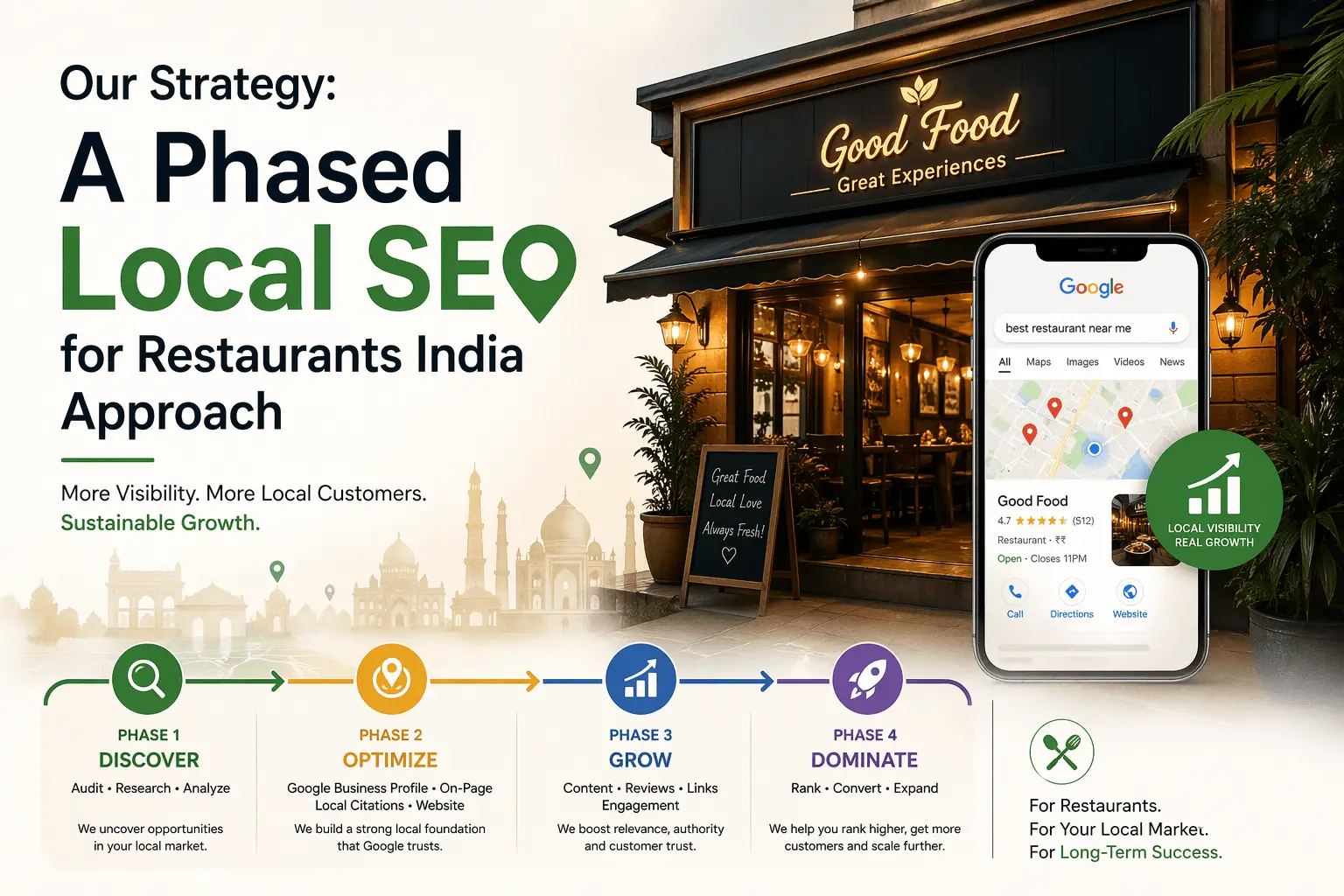
Our Strategy: A Phased Local SEO for Restaurants India Approach
We structured the engagement into four phases, with each phase building the foundation that the next one required. This approach — foundation before promotion — is the defining principle behind every successful local SEO for restaurants India engagement we have run.
Phase 1: Google Business Profile Overhaul & Local SEO Foundation (Weeks 1–4)
The Google Business Profile is the single most important digital asset for any restaurant competing on local SEO. We treated it that way.
Every field was completed: primary and secondary business categories, service areas, accessibility features, special hours for festivals, and a properly structured description incorporating local keywords including 'traditional Odia restaurant,' 'cultural dining Odisha,' and 'Odia thali Cuttack.' We conducted a two-day photography shoot, uploading forty-seven high-quality images across food, interior, team, and ambience categories.
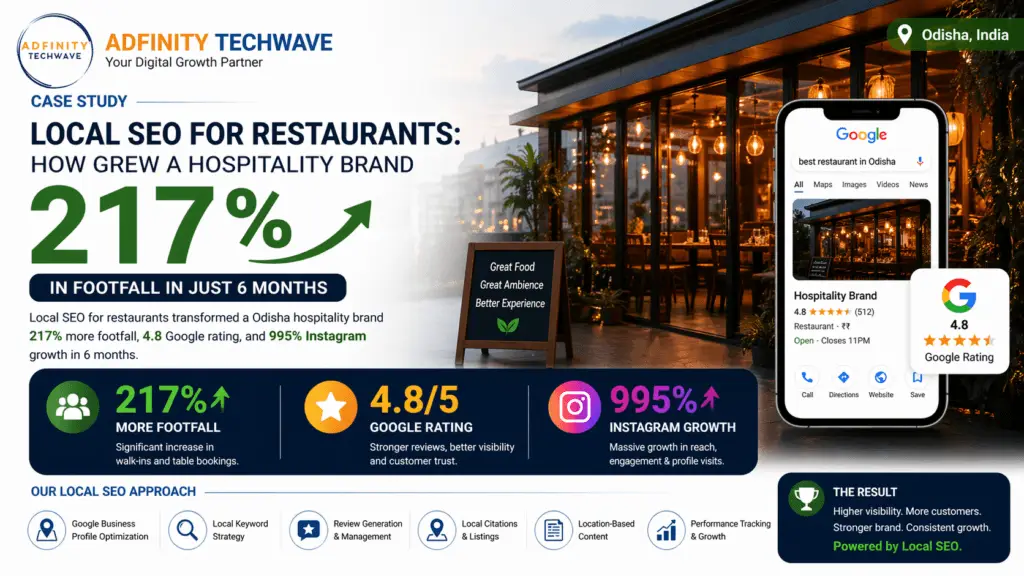
We built a review generation system using table-top QR cards with a staff script we wrote specifically for this brand — warm, conversational, never pushy. Within the first four weeks, the restaurant went from 11 reviews to 58, with an average rating of 4.7. By the end of the six-month engagement, they had 214 reviews with a 4.8-star average.
We also conducted full NAP (Name, Address, Phone) consistency work across 18 online directories — Justdial, Zomato, Swiggy, Sulekha, IndiaMart, and others — correcting inconsistencies that had been silently suppressing their local SEO authority for years. According to Semrush's local SEO research, inconsistent NAP data is one of the most common and most fixable local ranking suppressors.
Keyword mapping covered 22 primary and secondary local search terms across three intent categories: discovery queries, occasion queries, and cultural queries. Each was mapped to a specific content touchpoint — GBP description, Q&A, website landing page, or social caption.
Phase 2: Brand Identity & Visual Language (Weeks 3–6)
Running parallel to the local SEO foundation work, our design team built a complete visual identity system for the restaurant. The brief was specific: the brand needed to feel authentically Odia — drawing on Pattachitra-inspired motifs and the region's artistic heritage — while working at every scale from a restaurant menu to an Instagram Reel thumbnail to a banner hoarding.
We developed a three-colour primary palette, a two-font typographic system, and a recurring pattern library. We also produced a branded photography style guide so the client's own team could take consistent photos for stories and spontaneous moments without needing a professional photographer every time.
The visual identity work had no direct line to any traffic metric. What it produced instead was something less measurable but equally important: credibility. The first three social posts published under the new brand identity received double the engagement of anything the restaurant had previously posted. Not because the content was dramatically different — because it looked like a business worth trusting.
Phase 3: Social Media Marketing & Vernacular Content for Restaurant Digital Marketing India (Weeks 5–24)
The content strategy was built around three pillars, each targeting a different audience state.
Forty percent of all content was produced in the Odia language. This was a deliberate strategy rooted in the audience data: over 60% of the restaurant's Instagram followers and GBP visitors were from Odisha, and the Odia-language content consistently outperformed English content on saves and shares — the metrics that signal genuine audience resonance, not just passive exposure.
We also set up Instagram Shopping tags on food photos — a feature that has become a meaningful restaurant digital marketing India tool as Instagram's social commerce infrastructure has matured. This allowed users discovering the restaurant through a reel or explore-page post to immediately view menu items, see prices, and click through to the reservation page without leaving the app. According to Hootsuite's 2026 Social Trends research, AEO techniques are increasingly relevant to social content — optimising social posts for answer-engine discovery as well as platform algorithms.
Phase 4: Performance Tracking & Continuous Optimisation (Months 4–6)
Every successful local SEO for restaurants India strategy requires a measurement loop tight enough to course-correct within weeks, not quarters. We built a weekly reporting dashboard tracking seven core metrics: Google Business Profile views, direction requests, call clicks, website visits from GBP, Instagram reach, profile visits, and direct message enquiries.
The data guided real decisions. In month three, short-form video featuring the kitchen team was receiving 2.3× more shares than static food photography. We shifted the content mix from 30% video to 55% video the following month. By month five, video accounted for 68% of all social reach.
We used Google Search Console monthly to identify which keywords were gaining impressions but not yet ranking on page one, and refined on-page content to push those terms up.
The Results: What Local SEO for Restaurants India Delivered in Six Months
The numbers below come directly from Google Business Profile analytics, Instagram Insights, and restaurant POS data shared with us at the end of the engagement. All figures are real. This is what a properly executed local SEO for restaurants India strategy, combined with social media marketing and brand identity work, actually produces.
What These Numbers Actually Mean for the Business
Numbers require context. The 94 direction requests in March 2026 — up from 12 — represent real people actively navigating to the restaurant using Google Maps. At a standard hospitality visit conversion rate of approximately 70%, that is roughly 66 new physical visits per month attributable directly to local SEO work. That is a table that was previously empty, now occupied by someone who found the restaurant through a search.
The jump from 11 to 214 reviews changed how new customers perceived the business before they walked in. Consumer psychology research consistently shows that a business with 200+ reviews is evaluated categorically differently from one with fewer than 20 — the question shifts from 'is this place any good?' to 'what should I order?'
The 217% festival season walk-in increase was the result that genuinely surprised the client. For the first time in the restaurant's history, it was fully booked on three consecutive weekend evenings during the Diwali and winter festival season. The occasion-based content strategy we had been building toward since November paid off precisely when it was designed to.
Key Lessons from This Local SEO for Restaurants Case Study
The lessons from this engagement apply broadly to any hospitality brand in India navigating the 2026 digital landscape. Local SEO for restaurants in India is not a single tactic — it is a layered system in which each component amplifies the others.
1. Google Business Profile is the Primary Asset for Local SEO for Restaurants India
More restaurant discovery searches begin on Google Maps than anywhere else. A fully completed, regularly updated Google Business Profile is the highest-ROI activity available to any physical restaurant in India — and the majority of it costs nothing. The Kerkar Media 2026 Local SEO for Restaurants guide notes that a complete GBP receives 7× more clicks than an incomplete one. Seven times. No paid campaign produces that kind of return.
2. Review Velocity is a Direct Local SEO Ranking Factor
Going from 11 to 214 reviews with a 4.8-star average moved this client from invisible to dominant in local pack results. According to the Malou 2026 Restaurant SEO research, review collection will remain a top SEO tool throughout 2026 — provided the responses are authentic and conversational rather than keyword-stuffed. Building a simple, ethical review generation system is among the most impactful investments any restaurant can make.
3. Vernacular Content is a Competitive Advantage in Restaurant Digital Marketing India
73% of Indian internet users prefer regional-language content. For a brand rooted in Odia culture, producing content in Odia was not just authentic — it was the highest-performing content segment by every metric that matters: saves, shares, and profile visits. Any hospitality brand in India serving a regional audience that is producing only English content is systematically underperforming its potential.
4. Brand Consistency Multiplies Every Other Digital Marketing Effort
The visual identity investment in Phase 2 had no direct traffic number attached to it in the first week. What it produced over six months was a consistent doubling of engagement rates, higher quality user-generated content that tagged the brand, and a social presence that looked trustworthy rather than improvised. Brand consistency compounds slowly — and it compounds without stopping.
5. Foundation Before Promotion — Always
We spent four weeks on foundational local SEO for restaurants India work — GBP, brand identity, NAP consistency — before publishing a single promotional post. The results compounded faster because the foundation was solid. Running campaigns on an unfinished foundation is how budgets get wasted.
Services Behind This Restaurant Digital Marketing Result
This engagement drew on five service lines from Adfinity Techwave's full digital marketing portfolio. Each played a distinct role at a specific phase of the strategy. You can explore the complete service offering at Our Services
Further Reading & External Resources
What Comes Next for This Client
Six months of local SEO for restaurants India work has built a foundation that now generates compounding returns without proportionate additional effort. The review system runs independently. The brand identity is established. The content team has internalised the brand voice.
The next phase — beginning April 2026 — focuses on three new objectives: WhatsApp-based loyalty marketing for repeat customers, a structured influencer collaboration with Odia food creators, and a content cluster around Odia cuisine targeting informational queries to capture discovery traffic from outside the immediate local area.
The longer-horizon ambition is to make this restaurant a regional destination — a place food-curious visitors seek out specifically when they travel to Odisha. That is a three-year objective, but the six-month foundation makes it credible.