Zero-Click Search Results: Best Strategies to Rank in 2026

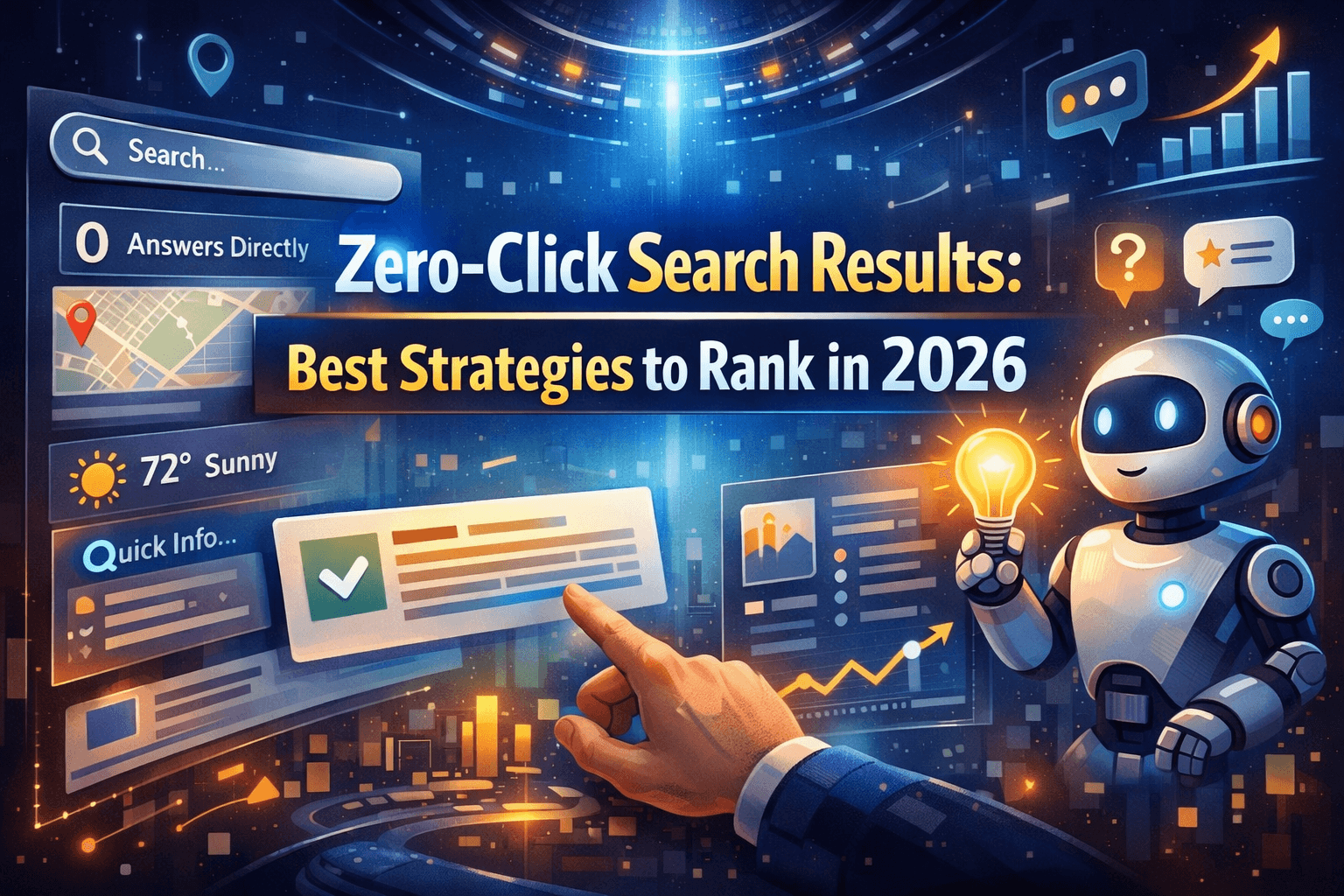
Futuristic digital banner showing AI-powered search results, featured snippets, and zero-click answers with a robot and data interface, representing strategies to rank in zero-click search results in 2026

Share this post:

Search has crossed a threshold it will not return from. In 2026, more than 80% of all Google searches end without a single click — a figure confirmed by Similarweb and accelerated by the January 2026 rollout of Gemini 3. For any business that relies on organic traffic, understanding zero-click search results is no longer optional — it is foundational.


This guide covers every proven strategy to rank in zero-click search results in 2026, including Gemini 3 AI Overviews, Google’s AI Mode, Generative Engine Optimisation (GEO), and Answer Engine Optimisation (AEO).

What Are Zero-Click Search Results?


Zero-click search results are SERP features that provide users with direct, complete answers on the Google results page — eliminating the need to visit any external website. The user asks, Google answers, and the journey ends there. In 2026, zero-click search results are delivered through:

    • AI Overviews (Gemini 3) — AI-generated summaries now reaching over 1 billion users monthly, powered by Gemini 3 since January 27, 2026
    • AI Mode — Google’s conversational search interface, now at 75 million daily active users as of March 2026, replacing the traditional blue-link results page
    • Featured Snippets (Position Zero) — direct answer boxes appearing above all organic results
    • People Also Ask (PAA) boxes — expandable Q&A sections surfaced from authoritative content
    • Knowledge Panels — branded entity information drawn from structured data and third-party directories
    • Local Packs — map-based results for location queries
    • Instant Answers — calculators, weather, currency converters, definitions, and sports scores

Zero-Click Search Results in 2026: The Numbers

MetricFigureSource
Google searches ending without a click80%+Similarweb, 2026
Zero-click rate for AI Overview queries83%Industry data, 2026
Organic CTR drop with AI Overviews present−61%Seer Interactive, Sept 2025
Monthly AI Overviews users globally1 billion+Google, January 2026
Daily active AI Mode users75 millionMarch 2026
AI referral conversion rate premium4.4×vs. standard organic
URL overlap: AI Overviews vs AI Mode13.7%Ahrefs

Critical 2026 Development: Gemini 3 + AI ModeAccording to Ahrefs research, AI Overviews and AI Mode cite the same URLs only13.7% of the time. Optimising for one does not guarantee visibility in the other — both require separate strategies. This is the single biggest blind spot in most zero-click search results strategies today.

Why Ranking in Zero-Click Search Results Is Non-Negotiable in 2026

The February 2026 Core Update explicitly rewarded content demonstrating first-person experience and f
    1. AI Overviews on Gemini 3 are smarter and more selective. Gemini 3 achieves a 1501 Elo score on LMArena — it can assess content quality, detect fluff, and prefer sources with documented expertise over generic coverage.
    1. AI Mode eliminates the blue-link safety net. In AI Mode, there are no organic results below the AI answer. You are either cited or you are invisible. There is no position 4 to fall back on.
    1. Multi-platform AI search is fragmenting visibility. ChatGPT, Perplexity, and Microsoft Copilot each have growing referral ecosystems. LinkedIn is now the most-cited domain for professional queries across all major AI platforms (Profound, March 2026).

12 Best Strategies to Rank in Zero-Click Search Results in 2026

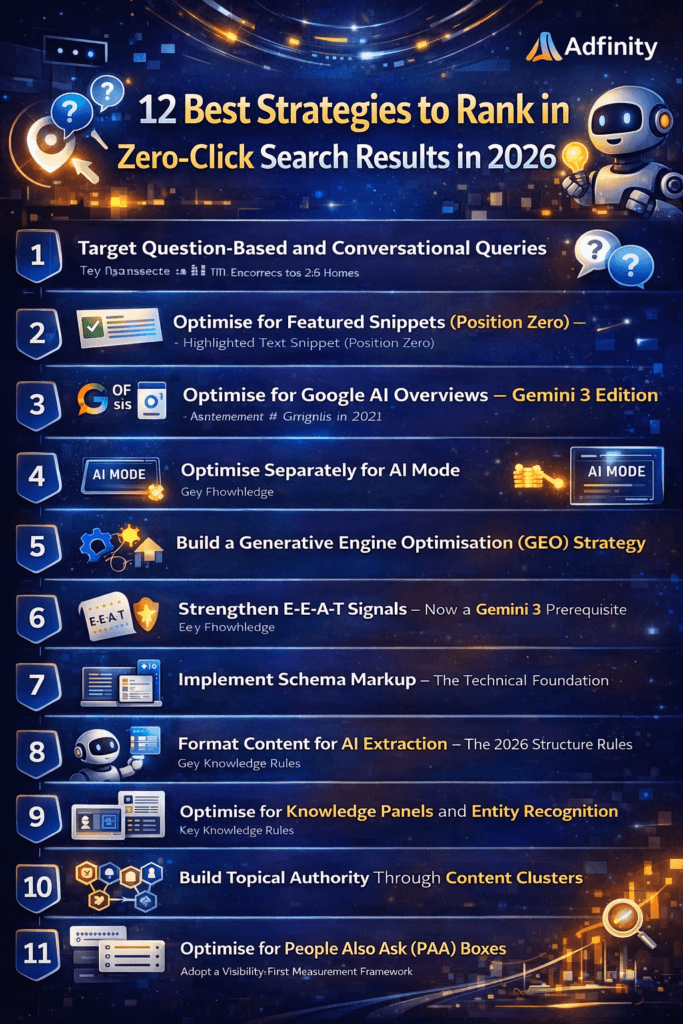
Infographic showing 12 SEO strategies to rank in zero-click search results in 2026, including featured snippets, Google AI overviews, E-E-A-T, schema markup, content clusters, and generative engine optimization, with Adfinity Techwave branding in the corner

1. Target Question-Based and Conversational Queries

The majority of zero-click search results are triggered by question-format queries. Answer every question heading within the first 40–60 words — no preamble. Use question-format H2 and H3 headings, add an FAQ section via Rank Math’s FAQ Block, and research active People Also Ask questions for your target keyword.y.

Effective question formats to prioritise:

    • “What is [X]?” — triggers paragraph snippet extraction and AI definitional answers
    • “How does [X] work?” — triggers numbered process snippets and HowTo schema eligibility
    • “What are the best [X] for [use case]?” — triggers list snippets and comparative AI summaries
    • “Why does [X] happen?” — triggers explanatory AI Overviews for complex topics
    • “How to [accomplish task]?” — triggers both HowTo schema and step-by-step AI inclusion

Answer every question heading directly within the first 40–60 words — no preamble, no filler.

2. Optimise for Featured Snippets (Position Zero) — Still Essential in 2026

Core sources cited consistently in AI Overviews cover 42% of key facts for their topic (Surfer SEO, November 2025). Earning the featured snippet strongly correlates with AI Overview inclusion — making Position Zero one of the highest-ROI strategies for zero-click search results.

Snippet typeBest useQuery trigger
Paragraph40–60 word direct definition or answer“What is X?”
ListBullet or numbered steps from structured HTML“How to X” / “Best X”
TableClean HTML table for comparisons and data“X vs Y”
VideoTimestamped YouTube video answering the queryGrowing with Gemini 3

Structural formula for Position Zero: open with a concise definition (no preamble), keep the direct answer to 40–60 words, follow with a structured list or numbered breakdown, add a “Quick Answer” summary box at the top of key sections.

3. Optimise for Google AI Overviews — Gemini 3 Edition

Gemini 3 powers all AI Overviews globally since January 2026. For a deeper look at how AI is reshaping all organic rankings, read our guide on AI-First SEO: How to Rank in the Era of Generative Search 2026. Key Gemini 3 content signals:

    • Definitional lead sentences — Start every key section with “X is…” or “X refers to…” structures. AI systems extract these as anchor definitions.
    • Factual density — Include verified statistics with source attribution. Content updated in the past 3 months averages 6 AI citations vs. 3.6 for outdated pages (SE Ranking, November 2025).
    • Article length — Articles over 2,900 words average 5.1 AI citations vs. 3.2 for articles under 800 words.
    • Section depth — Pages using 120–180 words between headings receive 70% more AI citations than pages with sections under 50 words.
    • Freshness signals — Update content quarterly at minimum. Add a visible “Last Updated” date. AI systems demonstrably prefer recent content.

4. Optimise Separately for AI Mode

AI Mode is a fundamentally different retrieval system to AI Overviews. With only 13.7% citation URL overlap, pages appearing in AI Overviews often do not appear in AI Mode zero-click search results. To understand how generative AI is reshaping marketing channels more broadly, see our article on The Generative AI in Marketing Revolution. Prioritise real-time freshness, conversational content structure, and explicit entity naming throughout your content.

    • Real-time freshness — AI Mode runs Gemini 3 Flash and emphasises content recency far more than AI Overviews
    • Multi-turn conversational structure — Content that progressively covers introductory to advanced material aligns with AI Mode’s conversational intent
    • Technical crawlability — AI Mode issues up to 16 simultaneous sub-queries (the “fan-out” technique). Clean HTML, fast load speed, and mobile optimisation are prerequisites
    • Entity clarity — Explicitly name your brand, location, and core services throughout content

5. Build a Generative Engine Optimisation (GEO) Strategy

GEO extends your zero-click search results strategy beyond Google to ChatGPT, Perplexity, Microsoft Copilot, and Google Gemini. For a practical implementation roadmap tailored to smaller brands, read our detailed post on 7 Proven Generative Engine Optimisation Strategies for Small Businesses in 2026. The five core GEO techniques: entity-first content architecture, JSON-LD schema stacking, multi-platform AI citation monitoring, third-party authority building, and a quarterly content freshness protocol.

The five core GEO techniques:

  1. Entity-first content architecture — Open every key section with a Definition Lead sentence that names the entity and defines it precisely
  2. JSON-LD Schema stacking — Combine Article + FAQPage + Organization schema on every pillar page (Rank Math’s schema builder handles this natively)
  3. Multi-platform AI visibility monitoring — Track citations across ChatGPT, Gemini, Copilot, and Perplexity using tools like Profound, Semrush AI Toolkit, or Ahrefs AI mentions
  4. Third-party authority building — Earn editorial mentions in PR, industry publications, Reddit, LinkedIn, and Crunchbase. LinkedIn is currently the most-cited domain for professional queries across all major AI platforms (Profound, March 2026)
  5. Quarterly content freshness protocol — Update articles every 90 days with new data, revised statistics, and a visible change log
  1.  

6. Strengthen E-E-A-T Signals — Now a Gemini 3 Prerequisite

In 2026, E-E-A-T signals are a prerequisite for zero-click search results inclusion — not a differentiator. The February 2026 Core Update explicitly rewards first-person experience. For a full framework on building brand authority that search engines trust, see our guide on E-E-A-T Strategy: Proven Ways to Build Brand Trust in 2026. Include first-person signals (“In our testing of 500 accounts…”), author bios with verifiable credentials, and a visible “Last Updated” date on every article.

  • Include first-person experience signals: “In our analysis of 500 accounts…” or “Based on direct testing of…”
  • Author bios with verifiable credentials, publication history, ad active social profiles
  • Cite primary sources: Google Search Central, peer-reviewed research, official tool documentation
  • Maintain a visible “Last Updated” date and a content change log for long-form guides
  • Build an About page with team credentials, company history, and client evidence
  • Earn editorial backlinks from recognised industry publications — not directory links

7. Implement Schema Markup — The Technical Foundation

Schema markup is the technical backbone of zero-click search results visibility. According to Google Search Central’s structured data documentation, correct schema implementation directly improves rich result eligibility. If you need hands-on implementation support, explore our SEO services at Adfinity Techwave.

Schema typePurpose in 2026
FAQPageEnables PAA-style expandable Q&A in SERPs. Use Rank Math’s FAQ Block — it generates this automatically.
HowToTriggers step-by-step process display. Eligibility growing in Gemini 3 results.
ArticleSignals authorship, publish date, and content type. Required for AI Overview citation eligibility.
OrganizationPowers Knowledge Panel accuracy. Include logo, social profiles, and NAP data.
BreadcrumbListDisplays URL structure in results. Improves click confidence on lower-funnel pages.
SpeakableSpecificationMarks content eligible for voice search and smart speaker results — growing in relevance as AI assistants expand.

In Rank Math: Schema > Add New Schema > Select type > Complete all fields > Validate with Google’s Rich Results Test before publishing. Always stack Article + FAQPage on pillar pages.

8. Format Content for AI Extraction — The 2026 Structure Rules

Pages using 120–180 words between headings receive 70% more AI citations. Structure is a direct zero-click search results citation driver. Use short paragraphs (3–4 sentences max), descriptive H2 and H3 subheadings that function as standalone answers, bullet and numbered lists for all processes, HTML tables for comparisons, and Quick Answer boxes at the top of long sections.

Required formatting principles:

  • Short paragraphs — maximum 3–4 sentences per paragraph
  • Descriptive subheadings — every H2 and H3 should function as a standalone answer
  • Bullet and numbered lists — break all processes, comparisons, and lists out of prose
  • HTML tables — use for comparisons, tool recommendations, and structured data
  • Quick Answer / TL;DR boxes — place concise summaries at the top of long sections
  • Clean HTML — John Mueller confirmed in November 2025 that clean HTML works fine for AI extraction

9. Optimise for Knowledge Panels and Entity Recognition

Entity recognition determines whether Google can confidently cite your brand in zero-click search results. For businesses with a physical presence, this is especially critical — our post on Local SEO for Small Businesses: 10 Powerful Ways to Get More Customers covers exactly how to build local entity authority. Claim your Google Business Profile, maintain strict NAP consistency, implement Organization schema, and earn listings on Crunchbase and LinkedIn Company Pages.

  1. Claim and fully complete your Google Business Profile — respond to reviews, update hours, add photos quarterly
  2. Maintain strict NAP consistency (Name, Address, Phone) across all external directories
  3. Implement Organization schema with official name, logo URL, website, and all active social profiles
  4. Earn listings in high-authority directories: Crunchbase, LinkedIn Company Page, G2, Trustpilot, and industry-specific databases
  5. Build a comprehensive About page using consistent brand language that mirrors your schema
  6. For larger brands: pursue Wikidata entity creation — Wikipedia remains a significant trust signal for AI Overviews

10. Build Topical Authority Through Content Clusters

AI Overview citations for zero-click search results are reserved for comprehensively authoritative sources. Build a pillar page (2,800–3,200 words), cluster articles targeting subtopics, bidirectional internal links between all related posts, and a quarterly refresh cycle. Consolidate thin cluster articles — quality and depth beat volume in 2026.

  • Pillar page — one comprehensive 2,800–3,200 word guide covering the primary topic at full depth
  • Cluster articles — supporting posts targeting specific subtopics and long-tail question keywords
  • Bidirectional internal links — links from cluster to pillar and from pillar to cluster
  • Quarterly refresh cycle — update the pillar and top cluster articles every 90 days with new data
  • Content consolidation — merge thin or outdated cluster articles; quality and depth beat volume in 2026

11. Optimise for People Also Ask (PAA) Boxes

A single well-optimised page can earn multiple PAA placements for the same search — dramatically multiplying your zero-click search results real estate. Research active PAA questions, include each as an H3 heading, provide a direct 2–4 sentence answer immediately below, add them to Rank Math’s FAQ Block for FAQPage schema, and cover natural follow-up questions.

  1. Research active PAA questions in Google for each target keyword before writing
  2. Include each PAA question as an H3 heading within the article
  3. Provide a direct, 2–4 sentence answer immediately below each H3 — before any supporting detail
  4. Add the same questions to the Rank Math FAQ Block to generate FAQPage schema automatically
  5. Cover related follow-up questions that naturally arise after the primary answer

12. Adopt a Visibility-First Measurement Framework

Traditional CTR-based reporting captures less than half the value of a zero-click search results strategy. Track: SERP feature presence (snippets, PAA, Knowledge Panels, AI Overview citations), AI citation rate across ChatGPT/Gemini/Perplexity/Copilot, branded search volume growth, impression share, and AI referral traffic segmented in GA4 (these visitors convert at 4.4× the rate of organic). Semrush’s zero-click research provides an excellent benchmark framework for tracking these metrics.


New metricWhat it measures
SERP Feature PresenceTrack which features you appear in: snippets, PAA, Knowledge Panels, AI Overview citations
AI Citation RateMonitor how often your brand is cited in ChatGPT, Gemini, Perplexity, and Copilot responses
Branded Search VolumeRising branded search is a direct indicator of zero-click brand building working
Impression ShareVisibility before the click is now measurable value
AI Referral TrafficSegment in GA4; these visitors convert at 4.4× the rate of organic
Share of Voice in AIBenchmark your AI citation frequency vs. top 5 competitors

Common Mistakes When Targeting Zero-Click Search Results

  • Publishing AI-generated content without editorial review — Gemini 3 actively deprioritises thin, generic content in zero-click search results
  • Treating AI Overviews and AI Mode as identical — with only 13.7% URL overlap, both require separate strategies
  • Ignoring data privacy compliance — as you optimise for AI visibility, ensure your tracking and consent practices are compliant. Read our guide on GDPR and SEO: How Data Privacy Is Reshaping SEO Strategy in 2026
  • Burying the answer — any preamble before the direct answer reduces extraction probability
  • Failing to refresh content — stale content averages 40% fewer AI citations than recently updated pages
  • Neglecting schema — without FAQPage and Article schema, you are invisible to rich result algorithms even with excellent content
  •  

Want expert help ranking in zero-click search results?
Adfinity Techwave offers full SEO audits, AI Overviews optimisation, and schema implementation — done for you.

Frequently Asked Questions About Zero-Click Search Results​

What are zero-click search results in 2026?

Zero-click search results are SERP features — including Google AI Overviews (Gemini 3), AI Mode, featured snippets, Knowledge Panels, and PAA boxes — that deliver complete answers directly on the Google results page. In 2026, over 80% of all Google searches end without a click to an external website.

What is the difference between AI Overviews and AI Mode?

AI Overviews appear alongside traditional search results, powered by Gemini 3 and serving 1 billion+ users monthly. AI Mode replaces the traditional results page with a full conversational interface — there are no organic blue links. Both are forms of zero-click search results, but Ahrefs found only 13.7% URL overlap between what each system cites.

How do I rank in zero-click search results in 2026?

To rank in zero-click search results: answer questions directly within 40–60 words, use structured formatting, implement FAQPage and Article schema via Rank Math, strengthen E-E-A-T with first-person experience signals, build topical authority through content clusters, and optimise for both AI Overviews and AI Mode separately.

What is Generative Engine Optimisation (GEO)?

GEO is the practice of optimising content to be cited and referenced by AI-powered answer platforms — including ChatGPT, Google Gemini, Microsoft Copilot, Perplexity, and Google AI Overviews. Unlike traditional SEO which focuses on ranking in link-based results, GEO focuses on becoming the preferred cited source when AI systems construct answers.

Does appearing in zero-click search results reduce traffic?

For informational queries, organic CTR dropped 61% when AI Overviews appear. However, AI referral traffic converts at 4.4× the rate of standard organic visitors with 27% lower bounce rates. The volume of traffic may decrease but the quality increases — making zero-click search results visibility a net positive when measured correctly.

What schema markup should I use for zero-click SEO in 2026?

Prioritise FAQPage schema (Rank Math's FAQ Block generates this automatically), HowTo schema for step-by-step guides, Article schema for editorial content with authorship and date signals, and Organization schema for branded entity recognition. Stack Article + FAQPage + Organization on every pillar page. Validate all schema with Google's Rich Results Test before publishing.

How often should I update content for AI Overview inclusion?

Update key articles at minimum every 90 days. Content updated in the past three months averages 6 AI citations versus 3.6 for outdated pages — a 67% citation advantage. Add a visible "Last Updated: March 2026" date and update statistics with current data for high-authority pillar pages.

Want Latest Updates?

Subscription Form

our services

© Copyright 2025 powered by Adfinity Techwave