

GDPR and SEO are two disciplines that most digital marketers once treated as completely separate concerns — one belonging to the legal team, the other to the marketing department. That separation is no longer viable. As data privacy regulations tighten globally, as third-party cookies phase out, and as users demand greater control over their personal data, the technical and strategic foundations of SEO are being fundamentally rewritten.
For brands operating in India and internationally, understanding the intersection of GDPR and SEO is not just a compliance requirement — it is a competitive advantage. The brands that adapt their data strategy now will build more resilient, trustworthy, and future-proof digital presences than those that wait for enforcement to force their hand.
This guide breaks down exactly what is changing, why it matters for your search performance, and what you need to do about it — technically, strategically, and operationally.
“Privacy is not a feature you bolt on at the end. It is an architectural decision that shapes everything — including how well you rank.”
Brands that treat GDPR and SEO as an integrated discipline — rather than siloed functions — are already outperforming competitors who continue to separate the two.
What Is GDPR — and Why Should SEO Professionals Care?
The General Data Protection Regulation (GDPR) is a comprehensive data privacy law enacted by the European Union in May 2018. It governs how organisations collect, store, process, and share personal data belonging to EU residents. Even if your business is based in India, GDPR and SEO strategy are directly relevant if any portion of your website traffic comes from EU countries — which, for most websites with organic search visibility, it does.
Key GDPR principles that directly intersect with SEO operations include:
- Lawful basis for data processing — You must have explicit legal grounds to collect any user data, including analytics data.
- Informed consent — Users must actively opt in to data collection. Pre-ticked boxes and assumed consent are illegal under GDPR.
- Data minimisation — You may only collect data that is strictly necessary for the stated purpose.
- Right to erasure — Users can request deletion of their personal data at any time.
- Transparency — Users must be clearly informed about what data is collected, how it is used, and with whom it is shared.
Each of these principles has a direct operational impact on how you collect data, measure performance, and build your GDPR and SEO strategy from the ground up.
Beyond GDPR, similar regulations have emerged globally — India’s Digital Personal Data Protection Act (DPDPA) 2023, California’s CCPA, Brazil’s LGPD, and others. The regulatory direction globally is unambiguous: user privacy is being legislated at scale, and SEO strategies built on unrestricted data collection are increasingly operating on borrowed time.
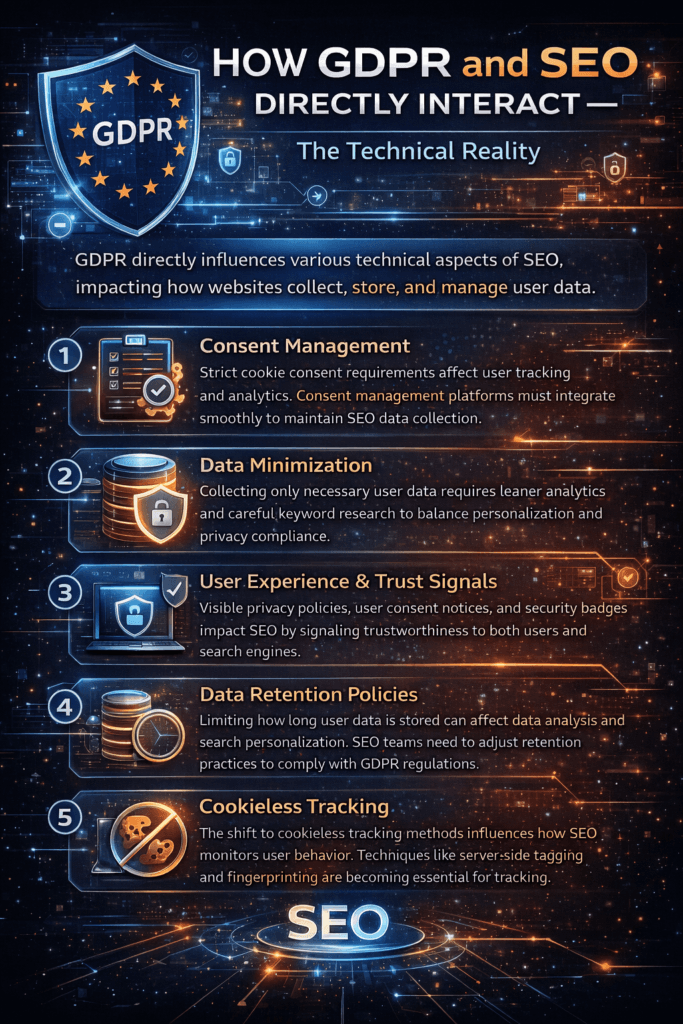
How GDPR and SEO Directly Interact — The Technical Reality
The relationship between GDPR and SEO is more technically complex than most marketers realise. Here are the primary points of intersection every SEO professional needs to understand.
The deeper you look into your analytics setup, your tag management configuration, and your consent infrastructure, the more clearly you will see how tightly GDPR and SEO performance are linked at a technical level.
1. Cookie Consent Banners and Crawlability
Cookie consent banners — now legally required under GDPR and the ePrivacy Directive — introduce a significant technical SEO risk that is frequently overlooked. If your consent management platform (CMP) is poorly implemented, it can:
- Block Googlebot from crawling key page content — if the consent banner overlay covers content that requires JavaScript to load, Google’s crawler may never see it.
- Slow page load times significantly — consent scripts add HTTP requests and render-blocking JavaScript, directly impacting Core Web Vitals scores, particularly LCP (Largest Contentful Paint) and FID (First Input Delay).
- Create inconsistent rendering — if your page renders differently for users who have not consented versus those who have, Google may index a stripped-down version of your content.
Getting your CMP configuration right is therefore one of the highest-leverage technical investments you can make in your GDPR and SEO performance — simultaneously reducing legal risk and improving search rankings.
The technical fix is precise: ensure your CMP loads asynchronously, does not block above-the-fold content rendering, and that Googlebot — which does not interact with consent banners — sees your full page content regardless of consent state. Google has explicitly confirmed that Googlebot does not click consent buttons and accesses pages as an unconsented user would.
2. Analytics Data Loss and SEO Decision-Making
When users decline cookies — which GDPR empowers them to do freely — your analytics platform stops receiving their data. Studies across European markets have shown that opt-out rates for non-essential cookies range from 30% to 60% depending on industry and CMP design. This means your Google Analytics data, your Search Console click data, and your conversion tracking may be missing nearly half of your actual traffic picture.
For GDPR and SEO strategy, this data loss has cascading consequences:
- Keyword performance data becomes incomplete — you may be making optimisation decisions based on a fraction of your actual search traffic.
- Conversion attribution breaks down — organic search may be significantly undervalued as a channel because post-consent conversions are not tracked.
- Audience segmentation for content strategy becomes unreliable — behavioural data used to inform topic selection and content gaps is skewed.
- A/B testing and CRO (Conversion Rate Optimisation) lose statistical validity when large portions of user sessions go unrecorded.
This is why a robust GDPR and SEO measurement framework must account for data gaps from the outset — rather than treating consented analytics data as a complete picture of organic performance.
3. Google Analytics 4 and GDPR Compliance
Google Analytics Universal Analytics (UA) was ruled illegal in several EU countries by data protection authorities, specifically because it transferred EU user data to US servers without adequate safeguards. This forced the migration to Google Analytics 4 (GA4), which was architected with privacy compliance as a core design principle.
Key GA4 features relevant to GDPR and SEO compliance include:
- IP anonymisation by default — GA4 does not store full IP addresses, reducing personal data exposure.
- Consent Mode — GA4’s Consent Mode API allows the platform to model and estimate traffic behaviour even when users decline cookies, using aggregated, anonymised signals rather than individual tracking.
- Data retention controls — GA4 allows you to set maximum data retention periods, helping comply with GDPR’s data minimisation principle.
- Server-side tagging — moving tag firing from the browser to a server you control reduces third-party data exposure and improves both privacy compliance and page performance.
Implementing GA4 correctly is now the technical baseline for any brand serious about GDPR and SEO compliance — and those that do it right gain a measurable data advantage over competitors still operating with legacy configurations.
Implementing GA4 with Consent Mode v2 — Google’s most recent iteration — is now the minimum technical standard for any brand serious about the intersection of GDPR and SEO performance measurement.
The Cookieless Future — What It Means for SEO Strategy
Google’s long-announced deprecation of third-party cookies in Chrome — repeatedly delayed but structurally inevitable — represents the most significant shift in digital marketing measurement since the introduction of web analytics itself. While SEO has always relied less on third-party cookies than paid advertising, the cookieless transition still has profound implications for how brands research, measure, and optimise their organic search performance.
Understanding the cookieless transition is now a non-negotiable component of any forward-thinking GDPR and SEO strategy — because the technical foundations of measurement and optimisation are shifting permanently.
First-Party Data Becomes the SEO Foundation
In a cookieless environment, first-party data — information that users willingly and directly provide to your brand — becomes the primary asset for understanding your audience and informing your content strategy. For SEO, this means:
- Email subscribers become a research panel — surveying your list about their search behaviours, pain points, and questions is now a legitimate primary research methodology for keyword and topic discovery.
- On-site search data (from your website’s internal search function) reveals exactly what your existing audience is looking for — directly informing content gap analysis without any third-party tracking dependency.
- CRM data provides audience insight that no third-party cookie could match — because it reflects real customer relationships, not probabilistic browser fingerprinting.
- User-generated content — reviews, comments, forum posts, support tickets — becomes a goldmine of semantic search intelligence that is both privacy-safe and authentically human.
Building a first-party data infrastructure is therefore the single most future-proof investment a brand can make in its GDPR and SEO strategy — one that becomes more valuable as third-party tracking options continue to diminish.
Google’s Privacy Sandbox and Organic Search
Google’s Privacy Sandbox initiative — the technical framework replacing third-party cookies in Chrome — introduces APIs designed to enable interest-based advertising without individual user tracking. While Privacy Sandbox is primarily relevant to paid search and programmatic advertising, its broader signal is important for GDPR and SEO strategy: Google is architecturally committed to a privacy-first web, and its organic ranking systems will increasingly reward websites that align with this direction.
Practically, this means websites that collect only necessary data, load consent-respecting scripts, maintain fast performance despite privacy tooling, and build transparent relationships with their users will be structurally advantaged in organic search — not just legally compliant.
Contextual Targeting Replaces Behavioural Tracking
One of the most significant strategic shifts in a cookieless world is the return of contextual relevance as the primary targeting and ranking signal. Without behavioural tracking data telling platforms who a user is based on their browsing history, the content of the page itself — its topic, depth, semantic coverage, and relevance to the user’s immediate query — becomes the dominant signal.
This is profoundly good news for brands with strong GDPR and SEO aligned content strategies. Deep, authoritative, topically comprehensive content that genuinely addresses user intent will outperform shallow, keyword-stuffed pages in a contextual-first world — exactly as Google’s own quality guidelines have always recommended.
This shift back to contextual relevance is perhaps the most strategically significant opportunity within the GDPR and SEO landscape — rewarding brands that have invested in deep, authoritative content over those that relied on behavioural data to compensate for content mediocrity.
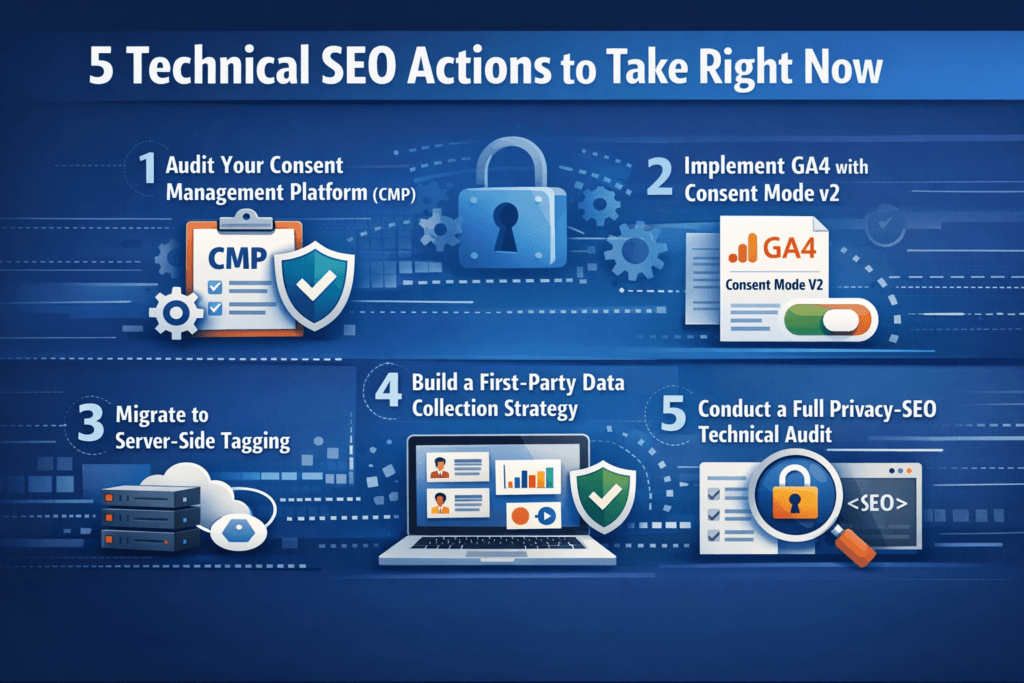
5 Technical SEO Actions to Take Right Now
Each of the following actions directly addresses a specific technical overlap between GDPR and SEO — prioritise them in the order listed for maximum impact.
1. Audit Your Consent Management Platform (CMP)
Your CMP is the technical gateway between user privacy and your data collection. A poorly configured CMP is simultaneously a legal liability and an SEO performance drag. Conduct a full technical audit covering:
- Does the CMP load asynchronously without blocking page rendering?
- Does it pass consent signals correctly to GA4 via Consent Mode v2?
- Does it create any render-blocking behaviour that impacts Core Web Vitals?
- Is Googlebot able to access and crawl your full page content regardless of consent state?
- Is the consent banner itself accessible — keyboard navigable, screen-reader compatible, and mobile-optimised?
Recommended CMPs that are both GDPR-compliant and technically SEO-safe include Cookiebot, OneTrust, and Usercentrics — all of which have native integrations with GA4 Consent Mode.
2. Implement GA4 with Consent Mode v2
If you are still running Universal Analytics remnants, legacy GTM configurations, or GA4 without Consent Mode, this is your highest-priority technical fix from a GDPR and SEO measurement perspective. Consent Mode v2 enables GA4 to use modelled data to fill the gaps left by non-consenting users — giving you a statistically more complete picture of your organic traffic without violating user privacy.
Implementation requires:
- Configuring your CMP to pass consent signals to the Google Tag via the gtag API
- Setting default consent states (typically denied) before any tags fire
- Enabling Google’s modelling by ensuring you have sufficient consented data as a baseline
- Validating implementation using Google’s Tag Assistant and the Consent Mode debugging view in GA4
3. Migrate to Server-Side Tagging
Server-side tagging moves your analytics and marketing tag firing from the user’s browser to a server environment you control — typically a Google Cloud or similar instance. The SEO and privacy benefits are substantial:
- Page speed improvement — fewer client-side scripts means faster page loads and better Core Web Vitals scores
- Reduced data exposure — third-party vendors receive only the data you explicitly choose to share with them
- Ad blocker resilience — server-side requests are less likely to be blocked by browser privacy extensions, improving data completeness
- First-party cookie extension — allows analytics cookies to be set as first-party, extending their lifespan and accuracy
4. Build a First-Party Data Collection Strategy
Every SEO-driven content piece should now include a deliberate first-party data collection mechanism — not as an afterthought, but as a core part of the content strategy. Practically this means:
- Gated content (whitepapers, research reports, templates) that exchanges genuine value for an email address
- Newsletter sign-ups positioned at natural content pause points — mid-article, at section breaks, at the end of long-form posts
- Interactive tools (calculators, assessors, quizzes) that require an email to receive results
- Webinar and event registrations that build a permission-based audience around your expertise
- On-site search functionality with query logging (with appropriate disclosure) to capture real audience intent signals
5. Conduct a Full Privacy-SEO Technical Audit
Most brands have never conducted a systematic audit of how their privacy infrastructure affects their SEO performance. A comprehensive GDPR and SEO technical audit should cover:
- Cookie audit — catalogue every cookie your website sets, classify each as essential or non-essential, and ensure non-essential cookies only fire post-consent
- Core Web Vitals impact assessment — measure page performance with and without consent scripts to quantify the performance cost of your current CMP
- Crawlability verification — use Google Search Console’s URL Inspection tool to verify Googlebot sees your full content
- Analytics data completeness check — compare GA4 sessions against server log data to estimate your actual data loss rate from cookie refusals
- Schema and structured data audit — ensure privacy policy, terms of service, and consent-related pages have appropriate schema markup
Common GDPR and SEO Mistakes Brands Make
Avoiding these mistakes is as critical to your GDPR and SEO performance as the proactive steps you take — because a single compliance misstep can simultaneously trigger regulatory scrutiny and damage your search rankings.
- Treating consent banners as purely a legal formality — Every CMP decision has technical SEO consequences. Legal and SEO teams must collaborate on implementation.
- Ignoring Consent Mode and relying on raw GA4 data — Without modelling enabled, your organic traffic data may be understated by 30–50%, leading to systematically poor strategic decisions.
- Using dark patterns in consent UI — Making the “reject” option harder to find than “accept” is both a GDPR violation and a trust signal risk. Google’s quality guidelines increasingly factor user experience signals into rankings.
- Assuming GDPR only applies to EU businesses — If your website has any EU traffic — which organic search almost inevitably generates — GDPR applies to that data regardless of where your business is incorporated.
- Neglecting India’s DPDPA — India’s own data protection legislation introduces similar consent and transparency requirements. Brands serving Indian users need a privacy strategy that addresses both frameworks simultaneously.
- Failing to update Privacy Policies when tools change — Every new analytics tool, pixel, or tracking script added to your website must be reflected in your Privacy Policy. Discrepancies between stated and actual data collection are both a compliance risk and a trust signal failure.
How Adfinity Techwave Builds Privacy-First SEO Strategies for Brands
At Adfinity Techwave, the convergence of GDPR and SEO is not a challenge we navigate reactively — it is a strategic capability we have built deliberately into every client engagement. We believe that privacy-first digital marketing is not just the ethical choice — it is the highest-performance choice for brands serious about long-term organic growth.
Our approach to privacy-aligned SEO strategy is structured around four pillars that directly mirror the technical and strategic realities outlined in this guide:
Technical Privacy Auditing: Every new client engagement begins with a comprehensive audit of their existing data collection infrastructure — CMPs, analytics configurations, tag management setups, and cookie inventories. We identify exactly where GDPR compliance gaps exist and where those gaps are simultaneously creating SEO performance drags through slow page loads, crawlability issues, or data loss.
GA4 and Consent Mode Implementation: We implement GA4 with Consent Mode v2 as a standard component of every SEO engagement — ensuring our clients have the most complete, privacy-compliant view of their organic search performance available. We configure server-side tagging where appropriate and validate every implementation against both GDPR requirements and Google’s technical specifications.
First-Party Data Strategy: We help brands build systematic first-party data collection into their content and SEO strategy — turning every high-ranking blog post, landing page, and resource into a permission-based audience building asset. This creates a compounding data advantage that becomes more valuable as third-party tracking options diminish.
Privacy-Aligned Content Architecture: Our content strategies are built from the ground up to perform in a contextual-first, cookieless world. Deep topical authority, semantic content clustering, and genuine E-E-A-T signals replace behavioural targeting dependency — creating organic search performance that is structurally resilient to any future privacy regulation or algorithm update.
Brands that partner with Adfinity Techwave on their GDPR and SEO strategy don’t just achieve compliance — they achieve a competitive positioning that is increasingly difficult for privacy-indifferent competitors to replicate. In a world where trust is the scarcest digital currency, being the brand that demonstrably respects user privacy is a differentiation strategy that compounds in value over time.
If your brand is ready to build a privacy-first SEO strategy that performs as powerfully as it protects, connect with the Adfinity Techwave team today for a comprehensive GDPR and SEO audit and strategy session.
The Bottom Line: Privacy Compliance and SEO Performance Are the Same Goal
The most important mindset shift any brand can make in 2026 is this: GDPR and SEO are not in tension — they are aligned. Both frameworks, at their core, are about serving users with genuine value, transparency, and respect. Google’s ranking systems and data protection regulators are, from different directions, demanding exactly the same thing from brands: be honest about what you collect, be genuinely useful to the people you serve, and build digital experiences that earn trust rather than extract it.
Brands that build their GDPR and SEO strategy around this alignment will find that every privacy investment they make also strengthens their organic search performance — creating a compounding return that grows more valuable over time.
Brands that internalise this alignment and build their GDPR and SEO strategy around it will find that privacy compliance becomes a source of competitive advantage rather than a cost of doing business. Their websites will load faster, their analytics will be more accurate, their content will rank more sustainably, and their audience relationships will be built on a foundation of genuine trust.
That is not just good compliance. That is good business.
“The brands winning in organic search in 2026 are not the ones with the most data — they are the ones with the most trust.”
Ready to align your GDPR and SEO strategy for 2026?
Adfinity Techwave delivers technically rigorous, privacy-first SEO strategies for brands across India and beyond. Get in touch with our team to schedule your GDPR and SEO audit today.