
An E-E-A-T strategy is no longer optional — it’s the defining factor in how Google ranks content in 2026. Every day, over 7.5 million blog posts are published worldwide, and a rapidly growing share are AI-generated. For brands and marketers, this creates the biggest opportunity of the decade: to stand out by being genuinely, provably human.
That’s the premise behind Google’s most consequential update to its search quality framework in years — the expansion of E-A-T (Expertise, Authoritativeness, Trustworthiness) to E-E-A-T, with the critical addition of a first letter: Experience.
Understanding and implementing a sound E-E-A-T strategy is now the baseline requirement for any brand that wants to compete seriously in organic search.
This isn’t a minor tweak. It’s a philosophical shift in how Google evaluates content — and how brands need to think about everything they publish online.
Building a strong E-E-A-T strategy means understanding what each pillar demands from your content — and then systematically proving it through everything you publish, every author you credit, and every external signal your brand generates.
“In a world where anyone can generate content, the only true differentiator is whether you’ve actually lived it, done it, and can prove it.”
Developing a focused E-E-A-T strategy is precisely how forward-thinking brands respond to this challenge — by making their real-world experience undeniable and visible to both readers and search engines.
What Exactly Is E-E-A-T — and Why Did Google Add the Second ‘E’?
Google’s Search Quality Rater Guidelines define E-E-A-T as a framework its human quality raters use to assess whether a webpage deserves to rank. Understanding each component is essential before you can act on it.
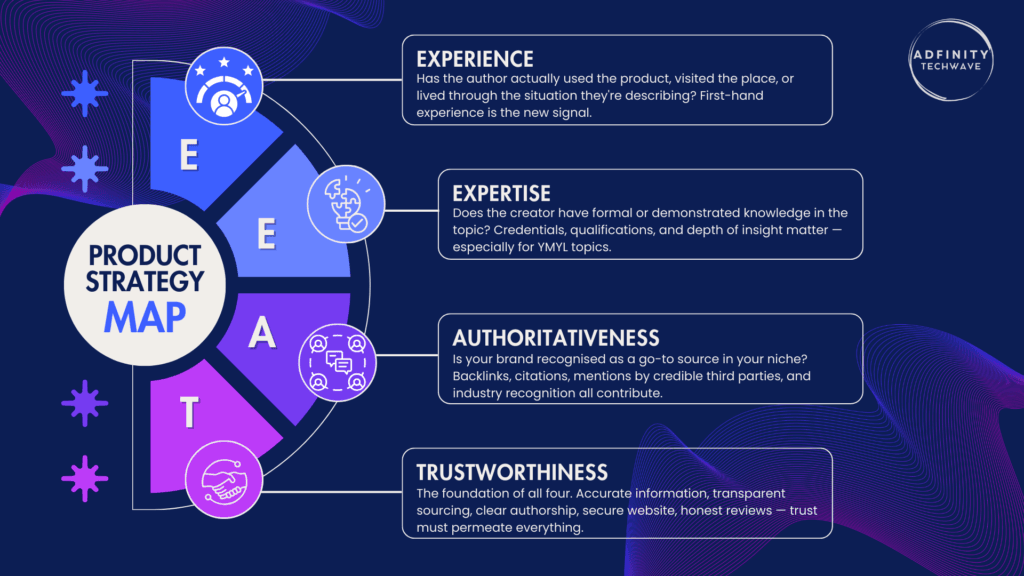
- Experience — Has the author actually used the product, visited the place, or lived through the situation they’re describing? First-hand experience is the new signal.
- Expertise — Does the creator have formal or demonstrated knowledge in the topic? Credentials, qualifications, and depth of insight matter — especially for YMYL topics.
- Authoritativeness — Is your brand recognised as a go-to source in your niche? Backlinks, citations, mentions by credible third parties, and industry recognition all contribute.
- Trustworthiness — The foundation of all four. Accurate information, transparent sourcing, clear authorship, secure website, honest reviews — trust must permeate everything.
Each of these four pillars must be actively addressed in your E-E-A-T strategy — none of them can be faked, automated, or shortcut. Google’s quality raters are trained to spot the difference between genuine authority and manufactured credibility.
The addition of Experience is Google’s direct response to the AI content explosion. A language model can synthesise information, but it cannot have walked into a client meeting, debugged a campaign at midnight, or watched a strategy pivot change a brand’s trajectory. That lived reality is exactly what Google now wants to see in content.
Why an E-E-A-T Strategy Matters More in 2026 Than Ever Before
Google’s Helpful Content System — which now operates site-wide, not page-by-page — explicitly penalises content that seems written primarily for search engines rather than to genuinely help people. Combined with E-E-A-T signals, this means that shallow, templated, or experience-thin content doesn’t just fail to rank well. It can actively drag down the authority of your entire domain.
The implications are significant for any brand competing in digital marketing, technology, professional services, health, finance, or any YMYL (Your Money or Your Life) category. Without a deliberate E-E-A-T strategy, your content may rank temporarily — but it will not hold its position as Google’s systems get better at identifying content that lacks genuine human experience behind it. Google wants proof — not assertions.
Key insights for brands:
- E-E-A-T signals affect your entire website’s authority — not just individual pages.
- AI-generated content without human experience signals is increasingly flagged as low-quality.
- Brands that invest in demonstrating real experience now will build a moat competitors can’t easily replicate.
- E-E-A-T is not an algorithm you can hack. It’s a reputation you have to earn — consistently, over time.
5 Proven E-E-A-T Strategy Tactics to Demonstrate First-Hand Experience

1. Lead with Specificity, Not Generality
Generic claims destroy credibility. “We have years of experience in digital marketing” tells Google — and your reader — nothing. Instead, prove it through specific, verifiable detail: campaign metrics, client industries, tools used, challenges encountered, and how you solved them.
For example, instead of saying “we help brands improve their SEO”, write: “In Q3, we helped a mid-size e-commerce brand in Odisha reduce their cost-per-click by 34% by restructuring their Google Ads account and aligning landing page content with high-intent search queries.” Specificity is the scent of real experience.
This level of specificity is what separates a surface-level content plan from a truly effective E-E-A-T strategy — one that signals to Google that a real expert with real results is behind the content.
✅ Action Step: Audit your existing blog posts and service pages. Anywhere you use vague language like “comprehensive solutions” or “industry-leading expertise” — replace it with a concrete example, number, or outcome.
2. Showcase the People Behind the Brand
One of the most powerful things you can do for E-E-A-T is make your team visible and credible. Every author who writes content on your website should have a detailed author bio page that includes professional background, areas of expertise, years of experience, and ideally, links to external profiles (LinkedIn, published work, speaking engagements). Making your team visible is one of the fastest, highest-impact improvements you can make to your E-E-A-T strategy — and it costs nothing beyond the time to write honest, detailed author profiles.
Google’s quality raters look specifically for “who is responsible for this content” — and if there’s no clear human behind it, the experience signal collapses. Author schema markup (structured data) makes this information machine-readable, helping search engines connect your content to a credible human entity.
3. Create Content Only You Can Write
The ultimate test of Experience-based content is simple: could a competitor or an AI produce exactly the same article? If yes, it’s not differentiated enough.
Content that passes the E-E-A-T test typically includes:
- Original research — surveys, data analysis, experiments
- Case studies drawn from real client work
- Opinion pieces grounded in lived professional experience
- Behind-the-scenes breakdowns of processes unique to your business
- Lessons from failures — because only someone who actually tried something can reflect on why it didn’t work
✅ Action Step: For your next 3 blog posts, start from a real experience: a client problem you solved, a trend you noticed in campaign data, or a question a client asked you last week. Let the lived reality drive the content, not a keyword brief alone.
This is the heart of any effective E-E-A-T strategy — producing content so grounded in real experience that no competitor and no AI tool could have written it in your place.
4. Build Your Brand’s External Reputation (Off-Site Authority)
Authoritativeness — the third pillar — cannot be built in isolation on your own website. Google assesses what other credible sources say about you. This means your E-E-A-T strategy must extend well beyond your blog.
- Earn quality backlinks from industry publications, directories, and partner websites in your niche.
- Contribute guest articles to respected digital marketing, tech, or business platforms where your team is credited by name.
- Get your brand mentioned in podcasts, webinars, award lists, or press coverage.
- Encourage and manage reviews on Google Business Profile, Clutch, or relevant directories — and respond to all reviews authentically.
- Participate in your community — local business networks, industry associations, speaking at events. Offline credibility feeds online authority.
Every one of these off-site signals feeds directly into the Authoritativeness pillar of your E-E-A-T strategy — and collectively, they tell Google that your brand’s credibility doesn’t begin and end on your own website.
5. Make Trust Structural, Not Cosmetic
Trust isn’t just about what you say — it’s about how your website and business operate at a systemic level. Google’s quality raters assess what they call the “reputation of the website” and “customer service information.” This means trust must be designed into your digital presence:
- Ensure your website uses HTTPS with a valid SSL certificate.
- Display clear contact information, a physical address, and business registration details.
- Maintain accurate, regularly updated content — outdated statistics or broken links erode trust fast.
- Use schema markup for organisation, reviews, and articles to make trust signals machine-readable.
- Publish a clear Privacy Policy and Terms of Service — small details that signal a legitimate business.
- Show social proof prominently: client logos, testimonials, case study outcomes, certifications.
These structural trust signals are the foundation layer of your E-E-A-T strategy — without them, even the best content will struggle to earn the credibility Google is looking for.
Repositioning Your Entire Content Strategy Around E-E-A-T

Applying E-E-A-T signals isn’t just about editing individual blog posts. It requires a strategic rethink of your entire content operation — especially if you’re in a competitive niche like digital marketing, fintech, health, or professional services.
Consider shifting from a quantity-first model (publishing as many posts as possible around target keywords) to a depth-first model (fewer, more substantive pieces that demonstrate genuine insight). This aligns with Google’s broader Helpful Content guidance, which explicitly rewards content that “goes beyond the obvious” and offers real value to readers.
This shift from quantity to depth is one of the most important mindset changes you can make when building an E-E-A-T strategy that lasts — because Google’s Helpful Content System rewards genuine insight, not publishing frequency.
A practical framework: for every piece of content you plan to publish, ask three questions before you write a single word:
- Who experienced this? — Which person on your team has real, first-hand knowledge of this topic?
- What do we know that others don’t? — What original data, insight, or perspective can we bring that isn’t already published elsewhere?
- Why should someone trust us on this? — What evidence — credentials, results, track record — validates our authority on this specific subject?
“The brands that will win in search over the next three years are the ones building a body of work so specific, so human, and so well-sourced that no AI could have written it.”
Common E-E-A-T Mistakes That Silently Hurt Your Rankings
Many brands are unknowingly undermining their own E-E-A-T signals. Here are the most common pitfalls to avoid:
Avoiding these mistakes is just as critical to your E-E-A-T strategy as the positive actions you take — because a single trust-eroding signal can undermine months of quality content work.
- Anonymous or byline-less content — If no human is credited, there’s no Experience or Expertise to evaluate.
- Thin author bios — A name and a headshot aren’t enough. Link credentials, show experience, establish topical authority.
- Conflicting or outdated information — Accuracy is non-negotiable. Outdated statistics, broken links, or factual errors all signal low trustworthiness.
- Over-reliance on AI-generated content without human review — AI can assist. It cannot replace the experiential layer Google is now actively looking for.
- Ignoring off-page signals — If your website is the only place that validates your expertise, your authority is self-declared, not established.
- Treating E-E-A-T as a one-time fix — It’s an ongoing practice, not a checklist to complete once.
How Adfinity Techwave Applies E-E-A-T to Client Strategies
At Adfinity Techwave, an E-E-A-T strategy isn’t a framework we discuss with clients in theory — it’s embedded in how we structure every content strategy and SEO engagement we deliver. From the first discovery call to the final content audit, every decision is made with Experience, Expertise, Authoritativeness, and Trust as the core filter.
When we work with a new brand, one of the first audits we conduct is an Experience Gap Analysis: a systematic review of where a brand’s website lacks demonstrable first-hand knowledge signals, and where competitor content is outranking them precisely because it proves experience more effectively.
From there, we help brands create Experience Content Architecture — a structured plan for which team members should be creating content, what original insights or data they’re sitting on that hasn’t been published, and how to build external credibility through partnerships, PR, and community participation.
Every brand we work with walks away with a clear, actionable E-E-A-T strategy tailored to their industry, their team’s expertise, and the competitive landscape they’re operating in.
The results speak to the strategy: brands that invest in genuine E-E-A-T signals don’t just see short-term ranking improvements. They build a compounding authority advantage — a body of work that becomes increasingly difficult for competitors to match.
📋 Your E-E-A-T Quick-Start Checklist:
- Add detailed, credential-rich author bios to all content pages.
- Implement Author and Organization schema markup site-wide.
- Audit content for specificity — replace vague claims with proof.
- Create at least 2–3 original data or case study pieces per quarter.
- Build a backlink acquisition plan targeting niche-relevant publications.
- Set up and actively manage your Google Business Profile with regular updates and review responses.
- Review your About Us and Contact pages — do they clearly establish your credibility and legitimacy?
- Ensure your website is technically sound: HTTPS, fast load times, mobile-optimised, and updated regularly.
Use this checklist as your E-E-A-T strategy audit — revisit it every quarter to ensure your signals stay strong and up to date.
The Bottom Line: Experience Is Now the Rarest Currency in SEO
That’s a race worth running. Brands that commit to a long-term E-E-A-T strategy don’t just climb the rankings — they build a compounding digital authority that becomes nearly impossible for competitors to replicate. And in a landscape where trust is the scarcest resource online, that authority is worth more than any paid campaign.
Investing in an E-E-A-T strategy today is investing in a form of digital authority that compounds over time — unlike paid ads that stop the moment you stop spending.
Ready to Build Your E-E-A-T Strategy?
Adfinity Techwave helps brands in India and beyond craft a data-driven E-E-A-T strategy rooted in genuine authority and first-hand expertise. Get in touch with our team to learn how we can help your brand rise in search — authentically.