
Imagine searching Google for a question and getting the complete answer instantly—without clicking a single website. That experience is becoming increasingly common. AI-generated summaries now appear directly at the top of many search results, pulling information from multiple sources and presenting it in a concise response.
For users, this is convenient. For businesses and marketers, it changes the rules of SEO. Instead of competing only for rankings, companies now need to compete to become the source AI systems trust when generating answers.This shift has given rise to a new approach: AI-First SEO.
Why Is Search Changing So Fast?
Search engines are rapidly evolving into AI-powered knowledge systems.
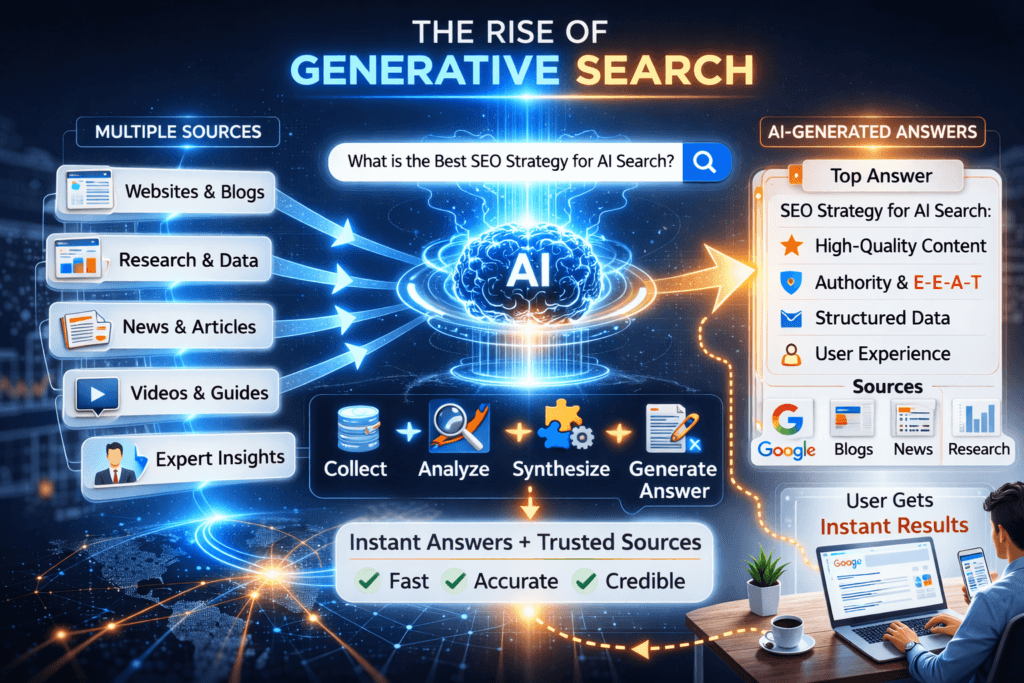
Generative search features analyze multiple sources, synthesize information, and deliver answers instantly. Instead of scrolling through a list of links, users often receive a summarized explanation within seconds.
Industry research suggests that AI-generated summaries already appear in a significant portion of search results and are expected to expand rapidly over the next few years. As AI capabilities improve, more users are interacting with search in a conversational way—asking full questions rather than typing short keywords.
This transformation has one major implication for marketers:Ranking alone is no longer the ultimate goal. Visibility increasingly depends on whether AI systems consider your content trustworthy enough to reference.
What Is AI-First SEO?
An AI-First SEO strategy focuses on optimizing content so it can be understood, trusted, and referenced by AI-powered search systems.
Traditional SEO primarily focused on ranking pages higher in search results. That meant optimizing keywords, building backlinks, and improving technical performance.
AI-First SEO expands that approach.
Instead of optimizing only for ranking algorithms, content must now be structured so AI models can:
- Understand the topic clearly
- Extract key information
- Summarize answers accurately
- Identify credible sources
This concept closely aligns with Generative Engine Optimization (GEO)—the practice of structuring content so generative AI systems can easily retrieve and cite it when producing responses.
In other words, the goal is no longer just to rank.
The goal is to become the source behind the answer.
The Rise of Generative Search
Think about how people search today.
Instead of typing:
“AI SEO”
Users increasingly ask questions like:
“What is the best SEO strategy for AI-powered search engines?”
Generative search engines are designed to answer exactly these types of queries.
They analyze multiple pages, identify reliable information, and generate a synthesized response. When done well, the system may reference specific websites that provide clear, authoritative explanations.For businesses learning how to rank in AI-powered search results, this creates both a challenge and an opportunity. The challenge is that users may receive answers without visiting your site. The opportunity is that if your content becomes one of the sources AI systems rely on, your brand gains significant authority and visibility.
How AI-First SEO Differs From Traditional SEO?
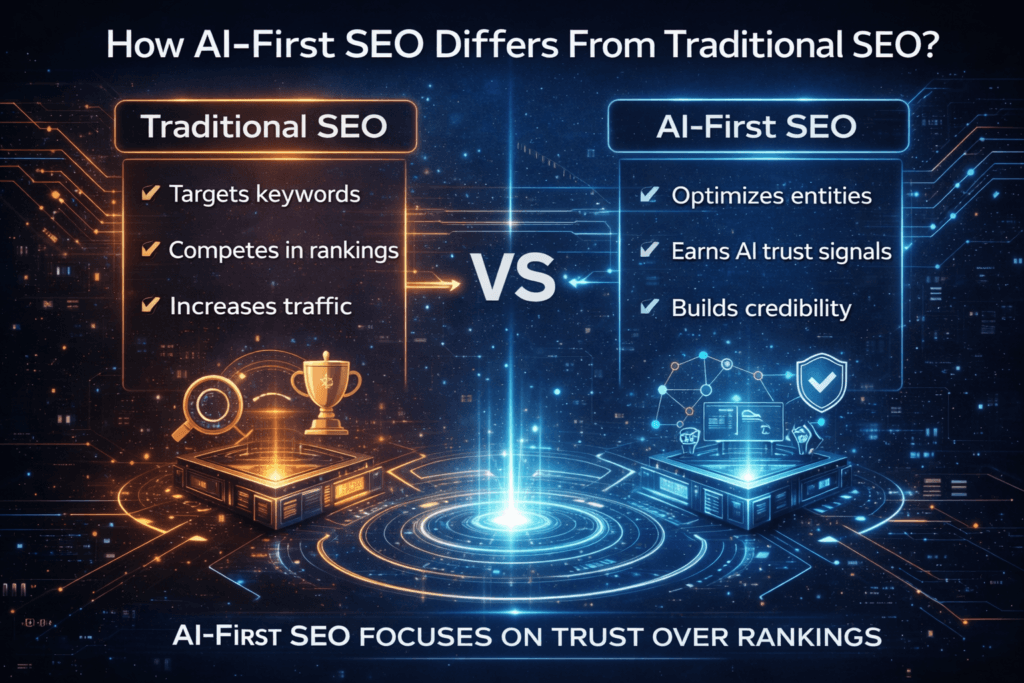
Traditional SEO was largely about outperforming competitors in search rankings.
AI-First SEO focuses on something slightly different: earning trust from intelligent systems that summarize information.
Instead of simply targeting keywords, modern optimization focuses on entities, context, and credibility signals.
In practical terms, this means:
- Content should answer real questions clearly
- Articles must demonstrate expertise and reliability
- Information should be structured for easy extraction
- Pages should provide depth rather than surface-level explanations
Search engines are no longer just ranking pages.They are interpreting knowledge.
The Core Pillars of AI-First SEO
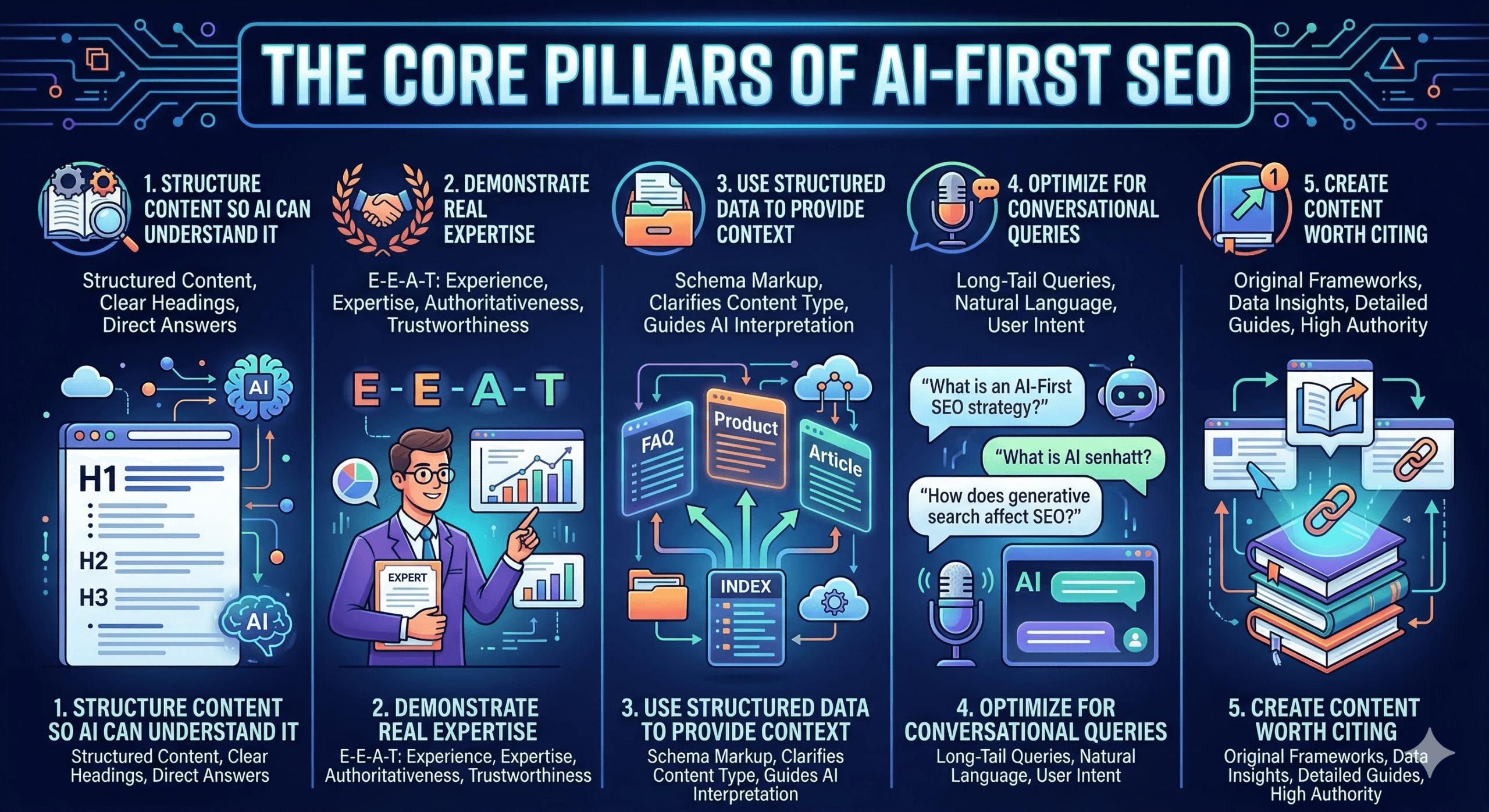
To succeed with SEO for AI search engines, content needs to meet several key criteria.
1. Structure Content So AI Can Understand It
AI systems favor content that is clear, structured, and easy to summarize.
For example, when someone searches for how to optimize content for Google AI Overviews, the system often pulls from pages that provide direct, concise explanations rather than long paragraphs of vague information.
Effective content usually includes:
- Clear definitions
- Short answer paragraphs
- Logical headings
- Lists or steps explaining processes
A simple technique that works well is placing a concise answer immediately under each question-style heading. This makes it easier for AI models to identify the core information.
It also improves readability for human readers.
2. Demonstrate Real Expertise
AI models evaluate credibility signals when deciding which sources to reference.
Content that shows genuine expertise is much more likely to appear in AI-generated answers.
This is where Google’s E-E-A-T principles matter:
Experience – Practical insights and examples
Expertise – Deep understanding of the subject
Authoritativeness – Recognition from credible sources
Trustworthiness – Accurate, transparent information
For example, an article explaining how to rank in AI-powered search results becomes far more credible if it includes real-world examples, data, and expert commentary.
Trust is no longer just a branding element—it’s an SEO signal.
3. Use Structured Data to Provide Context
Search engines rely on structured signals to understand the type of information on a page. Schema markup helps clarify whether content represents a guide, FAQ, product review, or article. This structure helps AI systems interpret the page more accurately.
For instance, adding FAQ schema to an article answering how to optimize content for Google AI Overviews makes it easier for search systems to identify the questions and answers within the page.
Think of structured data as providing a map that helps AI navigate your content.
4. Optimize for Conversational Queries
Generative search thrives on natural language.
Users increasingly type full questions instead of short keywords, which means content should reflect how people actually speak.
Instead of optimizing only for short phrases, modern SEO strategies include longer conversational queries such as:
- “What is an AI-First SEO strategy?”
- “How does generative search affect SEO?”
- “What are the best practices for SEO for AI search engines?”
These long-tail queries often have strong intent and provide excellent opportunities to capture AI-generated responses.
5. Create Content Worth Citing
Not every page becomes a source for generative search. AI systems tend to reference content that provides clear insights or unique explanations.
Articles that perform well often include:
- Original frameworks or models
- Data-supported insights
- Detailed explanations of complex topics
- Well-organized guides
This is why Generative Engine Optimization (GEO) focuses heavily on depth and clarity.
Generic content rarely gets cited. Authoritative knowledge does.
A Simple Framework for AI-First SEO
If you want to build an effective AI-First SEO strategy, a practical approach looks like this: First, identify the core topic you want to dominate and map out related concepts and questions users ask.
Next, structure your content so answers are clear and easy to extract. Use logical headings and concise explanations. Then, build topical authority by publishing multiple articles that explore different aspects of the subject and link them together.
Finally, ensure every article is reviewed by experts or knowledgeable editors. AI tools can help generate ideas or drafts, but human insight remains essential for accuracy and credibility.
What the Future of SEO Looks Like?
Search behavior is shifting rapidly as generative AI becomes integrated into everyday tools. Over the next few years, search results will likely include a mix of AI summaries, trusted sources, video explanations, and interactive answers.
In that environment, the brands that succeed will not simply chase rankings. They will focus on becoming reliable knowledge sources that AI systems consistently reference.
That’s the real goal behind modern SEO for AI search engines.
Final Thoughts
AI-First SEO represents the next stage in the evolution of search marketing. Traditional ranking signals still matter, but they are no longer enough on their own. Content must also be structured, authoritative, and trustworthy so AI systems can understand and reference it.
In the past, SEO success meant appearing at the top of search results. In the age of generative search, success increasingly means something bigger:
becoming the source behind the answer.
FAQs
1. What is AI-First SEO?
AI-First SEO is the practice of optimizing content so AI-powered search engines can easily understand, summarize, and cite it in generated answers.
2. How can you rank in AI-powered search results?
Create clear, structured, and authoritative content with concise answers, strong E-E-A-T signals, and schema markup.
3. How do you optimize for Google AI Overviews?
Use question-based headings, short direct answers, lists, and structured data to help AI systems extract information.
4. What is Generative Engine Optimization (GEO)?
Generative Engine Optimization focuses on structuring content so generative AI systems can retrieve and reference it in search responses.
5. Why is SEO changing with AI search?
AI search engines now generate answers directly in results, making credibility, structure, and expertise more important than rankings alone.